Week 1, Department of Obstetrics and Gynaecology (lecture by Dr Ritho). Rewritten as clinical notes: what to ask, what to examine, and what each finding means on the ward.
The reasoning chain: who is she and how risky is this pregnancy → how old is the pregnancy → what happened in earlier pregnancies → what is she complaining of today → is the mother well and is the baby well → what do the abdominal and pelvic findings say about lie, presentation and progress.
1. Take the history in this order
Identification and the chief complaint
Name, age (risk goes up below 20 years and above 35 years), marital status, address (a long distance from a health facility is itself a risk), religion, occupation, date of admission, ward and bed. She may come for routine antenatal care or with a complaint. Write each complaint with its duration, then explore it (for pain use SOCRATES) with associated symptoms, possible causes and fetal well-being.
Antenatal history of this pregnancy
- LNMP (last normal menstrual period) and EDD (expected date of delivery). Naegele's rule: LNMP − 3 months + 7 days. Then work out the gestational age in completed weeks and days.
- Quickening (first fetal movement felt): about 18–20 weeks in a first pregnancy, 16–18 weeks in later pregnancies. It helps to date the pregnancy when the LNMP is not known.
- Antenatal care elsewhere: where, how many visits, and what was done (supplements, vaccines, tests, ultrasound scans).
- Complications so far: bleeding, hyperemesis, urinary tract infection. Was the pregnancy unplanned, unwanted or unsupported?
- Always ask about danger symptoms: vaginal bleeding, severe headache, blurred vision, epigastric or severe abdominal pain, profuse vaginal discharge, reduced or absent fetal movement, fever, persistent vomiting. If present, add them to the presenting complaint.
Obstetric history
All previous pregnancies and outcomes.
- Gravidity: the number of pregnancies of any kind (term, preterm, stillbirth, abortion, ectopic, molar).
- Parity: pregnancies delivered after 28 weeks (Kenya and the UK), or 20 weeks or more by WHO definition. An abortion is a pregnancy loss before viability.
Worked example: one term delivery, one set of twins born at 32 weeks and two abortions = gravida 5, para 2 + 2, with three living children.
Four-number system (term–preterm–abortions–living): the same woman is para 1-1-2-3.
For each previous pregnancy, in order: date, length of gestation (abortion below 28 weeks, preterm below 37 completed weeks, term 37 to 42 weeks, post-term above 42 weeks), medical problems in that pregnancy (hypertension, antepartum haemorrhage, diabetes), onset of labour (spontaneous or induced), presentation, duration of labour, mode of delivery (vaginal, instrumental, caesarean section with its indication, destructive delivery), fetal outcome (alive or dead, sex, weight, malformations, current health) and postpartum complications such as postpartum haemorrhage.
Gynaecological history
Family planning (method, duration, side effects), sexual history for the risk of STIs and HIV, past operations (laparotomy, D&C, evacuation, manual vacuum aspiration, myomectomy) and the menstrual history: menarche, cycle length, duration and flow. Normal: cycle 21–35 days, flow 10–80 mL, 1–8 days, dark red without clots.
Past medical, surgical, drug, family and social history
- Diabetes, hypertension, thyroid disease: they affect pregnancy or worsen in it.
- Blood transfusion: matters for haemolytic disease of the newborn.
- Drugs: teratogenicity and allergies. Maternal infection: the TORCH group.
- Social: education, alcohol, smoking, drugs, occupation (radiation, halothane, chemical exposure) and income (low socio-economic status is linked to pre-eclampsia and preterm labour).
- Family history: diabetes, hypertension, multiple pregnancy, genetic disorders.
2. Examination: the rules before you start
Examine in a private room with a chaperone. Explain what you will do before, during and after. The patient should have emptied her bladder and be properly positioned. Use warm hands and instruments, good light, gloves and swabs, and keep eye contact.
General examination and vital signs
Look at the conjunctiva, sclera, teeth and buccal mucosa for pallor, jaundice, mucosal congestion and dental caries.
| Finding | What is normal or abnormal in pregnancy |
|---|---|
| Blood pressure | Use left lateral with 30° tilt (or sitting) to avoid the supine hypotensive syndrome |
| Pulse | Rises by 10–15 beats per minute |
| Respiratory rate | Rises by 1–4 breaths per minute |
| Weight | A gain of more than 1 kg a week is abnormal (fluid retention, pre-eclampsia) |
| Height | Below 150 cm may be constitutional but is a risk factor (contracted pelvis) |
Breasts: nipple retraction, pigmentation, lumps, discharge, colour change.
Heart and lungs: the steps are the same as in a non-pregnant woman, but the following are normal in pregnancy: reduced diaphragmatic movement (the uterus pushes the diaphragm up), a point of maximum impulse shifted to the left, a third heart sound and a functional systolic murmur.
Skin: pigmentation of breasts, lower abdomen, midline and genitalia is normal; so are spider naevi and palmar erythema.
3. The abdominal examination
Inspection
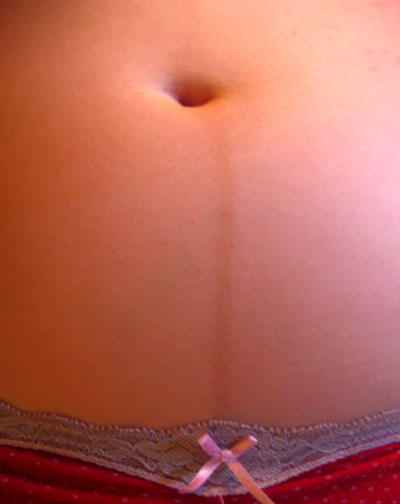
- Linea nigra: a dark midline line caused by melanocyte-stimulating hormone.
- Striae gravidarum: stretch marks that are purplish when new and white when old, caused by stretching.
- The umbilicus may be inverted, flat or everted. Look for scars, distended veins, flank fullness and visible fetal movement.

Palpation
Superficial (rigidity, tenderness, superficial masses, abdominal wall defects), then deep (masses, organs, tenderness), then obstetric palpation (Leopold's manoeuvres).
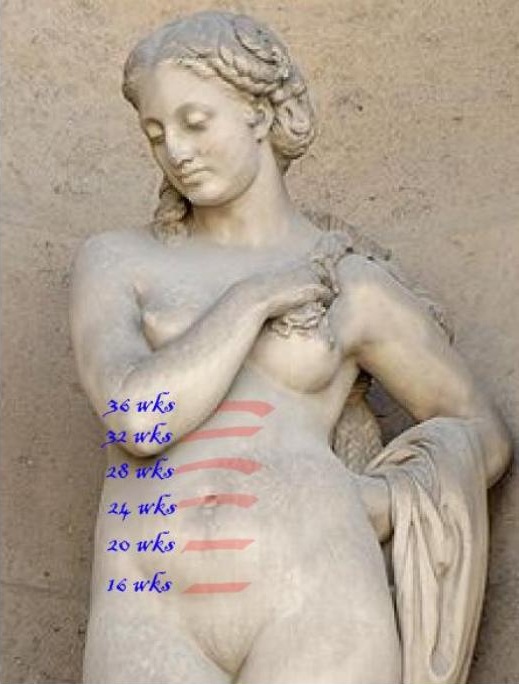
Fundal height: first correct any tilt of the uterus, then measure.
- Finger method: one finger above the umbilicus is 2 weeks, one finger below is 1 week. The uterus is felt at the symphysis at 12 weeks, at the umbilicus at 20 weeks and at the xiphisternum at term.
- Tape measure: symphysis to fundus in centimetres. Between 18 and 34 weeks it is accurate to within 2 weeks of the real gestational age.
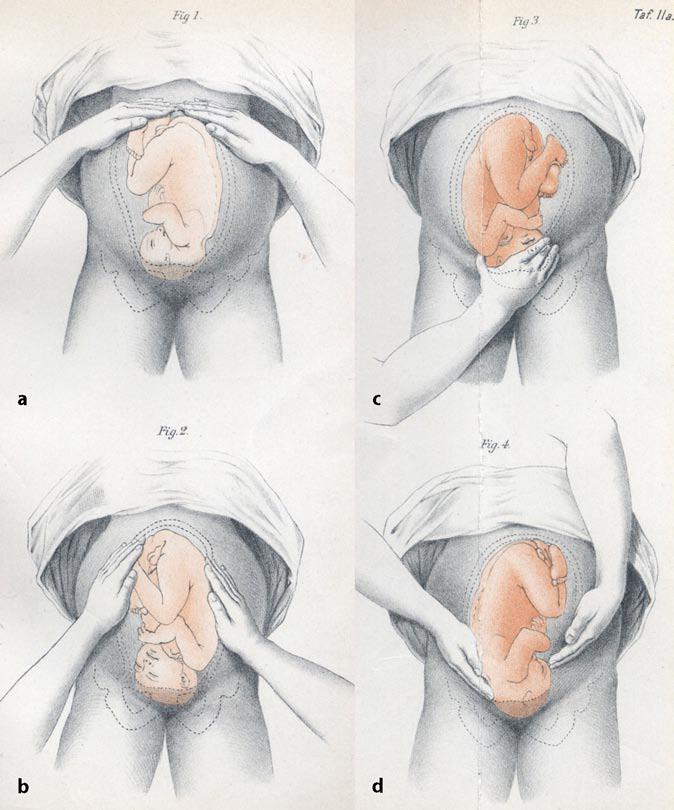
The four Leopold manoeuvres
| Manoeuvre | What you do and find |
|---|---|
| 1st: fundal | Measure the fundal height. A soft, irregular, bulky mass at the fundus is the breech; a hard, round, ballotable mass is the head |
| 2nd: lateral | Finds the lie (longitudinal, transverse, oblique) and, in a longitudinal lie, which side the back is on. The back is linear, rigid and smooth; the limbs are small, irregular and bulky. The fetal heart is best heard over the back |
| 3rd: pelvic | Finds the presentation: head (cephalic), breech or shoulder. In a cephalic presentation, descent is judged by the rule of fifths: 5/5 floating, 4/5 fixed, 2/5 engaged. Together with the 2nd manoeuvre it shows the attitude: extended (the head prominence is on the same side as the back), flexed (the opposite side), or military (both sides at the same level) |
| 4th: Pawlik grip | The only manoeuvre done with one hand; it checks the presenting part |
Percussion: shifting dullness and flank dullness, fluid thrill (ascites).
Auscultation
The fetal heart is first heard over the back at 16–18 weeks in a woman who has delivered before and 18–20 weeks in a first pregnancy. In a complete breech it is heard above the umbilicus; in a cephalic presentation below it; in an occipito-posterior position in the flanks.
4. Genitourinary and pelvic examination
Check for costovertebral and suprapubic tenderness. A pelvic examination in pregnancy is done only twice, or in complications or suspected labour: to diagnose a contracted pelvis, to find the Bishop score, and in labour to assess cervical dilatation and effacement, membranes and the colour of the liquor, the presenting part, station and position, moulding, caput and clinical pelvimetry.
External genitalia: pubic hair (inverted triangle in a woman), labia, ulcers, swellings, discharge, the hymen.
Speculum: vaginal colour (normally pink), septum, rugae, fornices, discharge, scars, lacerations. The cervix: colour, the os (pin-point in a nullipara, slit-like in a woman who has delivered), dilatation, effacement, bleeding or a mass.
Bimanual examination:
- Cervix: closed normally, moves 2–4 cm without pain, smooth, with the consistency of the tip of the nose.
- Uterus: non-tender, mobile, 9 cm long, pear-shaped, smooth and firm when not pregnant.
- Adnexa: normally not palpable except in a thin woman with a soft abdomen. Describe any mass.
5. Summarise the case like a clinician
End with a one-line summary (age, gravida and para, gestational age, the main problem), the problem list, a differential diagnosis, the investigations you want and the plan. An examiner asks "what worries you about this patient?", so say the risk out loud: extremes of age, grand multiparity, previous caesarean section, pre-eclampsia, bleeding, a small woman, a long distance to the hospital.
Examiner questions
- Define gravidity and parity, and give the gravida and para of a woman with one term delivery, a set of twins at 32 weeks and two abortions.
- Describe the four Leopold manoeuvres and what each tells you.
- Which findings in the heart and breathing examination are normal in pregnancy?
Practice questions
1. The expected date of delivery by Naegele's rule is: A. LNMP + 9 months − 7 days · B. LNMP − 3 months + 7 days · C. LNMP + 280 days − 7 days · D. LNMP + 40 weeks + 7 days · E. Conception + 9 months Answer: B.
2. A woman had one term delivery, one set of twins at 32 weeks and two abortions. She is: A. Gravida 4 para 2 · B. Gravida 5 para 2+2 · C. Gravida 5 para 3 · D. Gravida 3 para 2 · E. Gravida 6 para 2 Answer: B. Twins count as one pregnancy; abortions count towards gravidity and are shown after the plus sign.
3. On palpation the head is 2/5 palpable above the symphysis. The head is: A. Floating · B. Fixed · C. Engaged · D. Not descended · E. Crowning Answer: C.
4. Which manoeuvre is performed with one hand? A. First · B. Second · C. Third · D. Fourth (Pawlik grip) · E. All of them Answer: D.
5. The fetal heart is best heard over: A. The fetal limbs · B. The fetal back · C. The fundus always · D. The symphysis always · E. The flank in all presentations Answer: B.