Clinical reasoning notes for the bedside. Describe every murmur the same way, then ask what is causing it.
The reasoning chain: time it (systolic or diastolic) → place it (where is it loudest, where does it go) → grade it → use manoeuvres → name the lesion → ask what caused it and how bad it is.
1. What is a murmur?
A murmur is the extra sound made by turbulent blood flow across a valve or defect. A systolic murmur falls between the first and second heart sounds; a diastolic murmur falls after the second. Diastolic murmurs are always pathological. Many soft systolic murmurs in children and in pregnancy are harmless (flow murmurs).
2. Describe every murmur by
Timing (systolic or diastolic), site where it is loudest, radiation, grade, pitch and shape, and the effect of manoeuvres.
Levine grading: systolic murmurs are graded 1 to 6 (grade 4 and above has a thrill); diastolic murmurs 1 to 4.
3. Manoeuvres
- Right-sided murmurs are louder on inspiration (more blood returns to the right heart). Left-sided murmurs are louder on expiration. A simple way to remember it: right = in, left = out.
- Lean the patient forward in expiration to hear the early diastolic murmur of aortic regurgitation.
- Roll the patient to the left lateral position and use the bell to hear the mid-diastolic rumble of mitral stenosis.
4. The lesions
| Lesion | Murmur | Key features |
|---|---|---|
| Mitral stenosis | Mid-diastolic rumble at the apex | Loud first sound and opening snap; best with the bell, left lateral, in expiration |
| Mitral regurgitation | Pansystolic at the apex | Radiates to the axilla |
| Aortic stenosis | Ejection systolic, right 2nd intercostal space | Radiates to the carotids; slow-rising pulse |
| Aortic regurgitation | Early diastolic, left sternal edge | Patient sitting forward, in expiration; wide pulse pressure |
| Tricuspid stenosis / regurgitation | Diastolic / pansystolic | Louder on inspiration; raised JVP |
| Pulmonary stenosis / regurgitation | Ejection systolic / early diastolic | Left 2nd intercostal space |
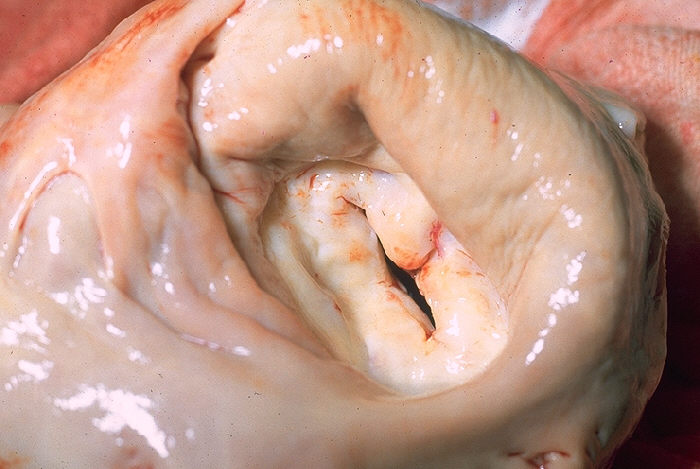
5. Peripheral signs of aortic regurgitation
A big pulse pressure produces a collection of named signs. Know them:
- Collapsing (water-hammer) pulse
- Corrigan's sign: visible "dancing" carotid pulsations
- de Musset's sign: the head bobs with each heartbeat
- Quincke's sign: pulsation of the nail-bed capillaries
- Traube's sign: a "pistol-shot" sound over the femoral arteries
- Duroziez's sign: a to-and-fro murmur over the femoral artery
- Müller's sign: pulsation of the uvula
- Becker's sign: pulsation of the retinal arteries
- Hill's sign: the leg systolic pressure is much higher than the arm
6. Always ask what is causing it
In many low- and middle-income countries, including Kenya, rheumatic heart disease is the leading cause of valve disease in young people. Mitral stenosis is nearly always rheumatic. Other causes: degenerative calcific aortic stenosis (older patients), a bicuspid aortic valve, infective endocarditis, mitral valve prolapse, and ischaemia (papillary muscle rupture after a heart attack). See the note on rheumatic fever for the Jones criteria.
7. Where the examination can mislead
- The loudness of a murmur does not equal the severity: a very severe mitral stenosis can have a soft rumble, and in severe aortic stenosis with heart failure the murmur may be quiet.
- Atrial fibrillation (common in mitral stenosis) makes timing difficult: take your time, and feel the carotid pulse while you listen.
- A new murmur plus fever means endocarditis until proven otherwise.
Examiner questions
- Where do you hear the murmur of mitral stenosis best, and how do you bring it out?
- List five peripheral signs of aortic regurgitation.
- Which murmurs get louder on inspiration?
Practice questions
1. A mid-diastolic rumble at the apex with an opening snap is characteristic of: A. Mitral regurgitation · B. Mitral stenosis · C. Aortic stenosis · D. Aortic regurgitation · E. Tricuspid regurgitation Answer: B.
2. A pansystolic murmur at the apex radiating to the axilla indicates: A. Aortic stenosis · B. Pulmonary stenosis · C. Mitral regurgitation · D. Mitral stenosis · E. Aortic regurgitation Answer: C.
3. Which finding is a peripheral sign of aortic regurgitation? A. Slow-rising pulse · B. Head bobbing synchronous with the pulse (de Musset's sign) · C. Pulsus paradoxus · D. Pulsus alternans · E. Raised JVP Answer: B. A slow-rising pulse belongs to aortic stenosis.
4. Which murmur becomes louder on inspiration? A. Mitral regurgitation · B. Aortic stenosis · C. Tricuspid regurgitation · D. Mitral stenosis · E. Aortic regurgitation Answer: C. Right-sided murmurs are louder on inspiration.