36 clinical MCQs in Biochemistry. The following are components of a protein synthesis initiation complex. —. Kenya, Africa and global revision.
-
Q1. The following are components of a protein synthesis initiation complex. ---
- Ribosome
- Initiator amino acyl tRNA on A-site
- Any amino acyl tRNA on P-site
- mRNA
- All the above
Answer: Ribosome
-
Q2. The following reactions are considered as part of salvage pathway for purine synthesis ---
- Hypoxanthine – guanine phosphoribosyl transferase (HGPRTase)
- Adenosine Phosphoribosyl transferase (APRTase)
- 5' – nucleotidase
- Adenosine deaminase
- All the above
Answer: Hypoxanthine – guanine phosphoribosyl transferase (HGPRTase)
-
Q3. Uracil can also be referred to as ---
- 2, 4 – dioxypyrimidine
- 2, 4 – dioxy-5-methyl pyrimidine
- 2 – oxy – 4 – amino pyrimidine
- Uridylate
- None of the above
Answer: 2, 4 – dioxypyrimidine
-
Q4. The reactions of 'purine nucleotide cycle' includes ---
- AMP – deaminase
- Adenyl succinate lyase
- IMP – dehydrogenase
- Adenyl succinate synthetase
- PRPP – amido transferase
Answer: AMP – deaminase
-
Q5. The importance of salvage pathway for purine biosynthesis is manifested in the condition(s) ---
- Gout
- Lesch-Nyhan syndrome
- Severe combined immunodeficiency (SCID)
- Orotate aciduria
- Associated with severe mental retardation and hyperuriceamia
Answer: Gout
-
Q6. With regards to anticancer properties, conversion of dUMP to dTMP is a key inhibitory reaction for a number of compounds as follows ---
- 5-Fluoro Uracil inhibits thymidylate synthase
- Methotrexate inhibits dihydrofolate reductase
- Aminopterin inhibits dihydrofolate reductase
- Methotrexate inhibits thymidylate synthase
- 5-Fluoro Uracil inhibits serine hydroxyl methyl transferase
Answer: 5-Fluoro Uracil inhibits thymidylate synthase
-
Q7. Carbamoyl phosphate synthetase reaction in mammalian nucleotide biosynthesis ---
- Is located in the cytosol
- Utilizes the $\alpha$-amino group of glutamate as the N-source
- Is located in mitochondria
- Requires N-acetyl glutamate as a positive effector/modifier
- Uses $\text{NH}_4^+$ as an N source
Answer: Is located in the cytosol
-
Q8. Polysaccharides ---
- Contain many monosaccharide units which may or may not be of the same kind
- May be easily separated from each other by ion-exchange chromatography or electrophoresis.
- May have amino acid residues attached after completion of the Carbohydrate backbone giving rise to glycoproteins and proteoglycans
- Are present in large amounts in connective tissue
- Function mainly as storage or structural components
Answer: Contain many monosaccharide units which may or may not be of the same kind
-
Q9. 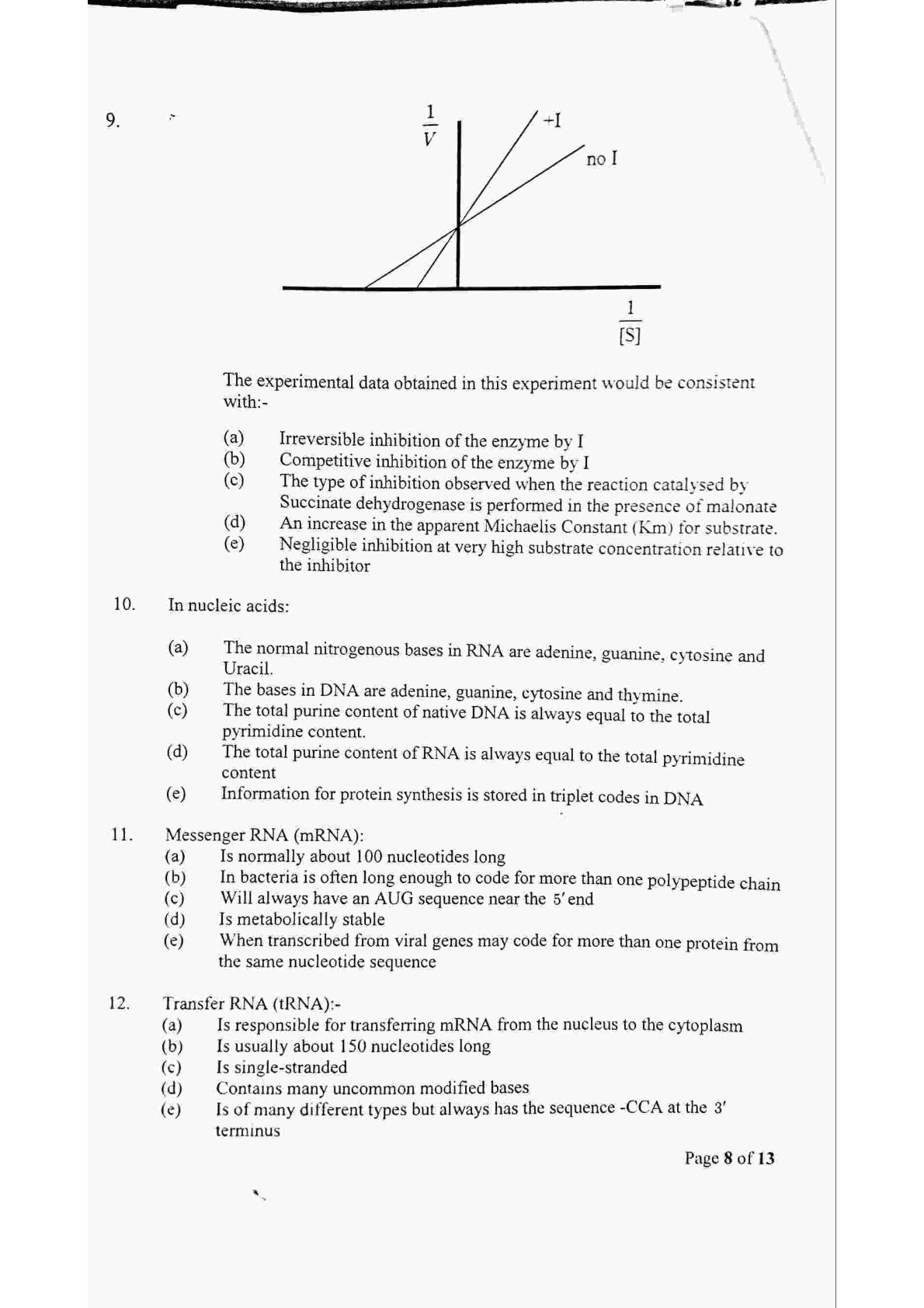 The experimental data obtained in this experiment would be consistent with ---
- Irreversible inhibition of the enzyme by I
- Competitive inhibition of the enzyme by I
- The type of inhibition observed when the reaction catalysed by Succinate dehydrogenase is performed in the presence of malonate
- An increase in the apparent Michaelis Constant (Km) for substrate.
- Negligible inhibition at very high substrate concentration relative to the inhibitor
Answer: Irreversible inhibition of the enzyme by I
-
Q10. In nucleic acids ---
- The normal nitrogenous bases in RNA are adenine, guanine, cytosine and Uracil.
- The bases in DNA are adenine, guanine, cytosine and thymine.
- The total purine content of native DNA is always equal to the total pyrimidine content.
- The total purine content of RNA is always equal to the total pyrimidine content
- Information for protein synthesis is stored in triplet codes in DNA
Answer: The normal nitrogenous bases in RNA are adenine, guanine, cytosine and Uracil.
-
Q11. Messenger RNA (mRNA) ---
- Is normally about 100 nucleotides long
- In bacteria is often long enough to code for more than one polypeptide chain
- Will always have an AUG sequence near the 5' end
- Is metabolically stable
- When transcribed from viral genes may code for more than one protein from the same nucleotide sequence
Answer: Is normally about 100 nucleotides long
-
Q12. Transfer RNA (tRNA) ---
- Is responsible for transferring mRNA from the nucleus to the cytoplasm
- Is usually about 150 nucleotides long
- Is single-stranded
- Contains many uncommon modified bases
- Is of many different types but always has the sequence -CCA at the 3' terminus
Answer: Is responsible for transferring mRNA from the nucleus to the cytoplasm
-
Q13. Vitamin C deficiency leads to ---
- Overproduction of sterols
- Neurological disorders
- Sore spongy gums
- Impaired collagen synthesis
- All of the above
Answer: Overproduction of sterols
-
Q14. In many cases, action of cytochrome $\text{P} {450}$ ---
- Leads to formation of less toxic products
- Leads to chemical alteration of xenobiotics
- Is associated with mono-oxygenase activity
- Is associated with chemically contaminated environments
- All of the above
Answer: Leads to formation of less toxic products
-
Q15. Vitamin K deficiency may occur in adult humans due to ---
- Malabsorption from gut
- Sterility of gut
- Antibiotic use
- Inefficient transfer across placenta
- All of the above
Answer: Malabsorption from gut
-
Q16. Methanol poisoning is associated with ---
- Acetaldehyde
- Formaldehyde
- Activity of alcohol dehydrogenase
- Carbon-dioxide
- All of the above
Answer: Acetaldehyde
-
Q17. Bacterial cell wall synthesis ---
- Is target for antibiotic activity
- Takes place exclusively outside the cell
- Takes place exclusively inside the cell
- Involves use of a transpeptidase
- All of the above
Answer: Is target for antibiotic activity
-
Q18. Biological molecules are functionally active only within a narrow range of environmental conditions with denaturation occurring due to ---
- Dramatic increase in temperature
- Large changes in ionic strength
- Refrigiration
- Addition of strong acids and bases
- None of all the above will denature biological macromolecules
Answer: Dramatic increase in temperature
-
Q19. The following are examples of phospholipids ---
- Triacylglycerols
- Cholesterol
- Cephalins
- Lecithins
- Plasmalogens
Answer: Triacylglycerols
-
Q20. The solubility of alcohol in water ---
- Decreases as the number of -OH group present increases
- Increases with increasing molecular mass
- Increases as the carbon chain length increase
- Is due to the hydrogen bonding between alcohol and water molecules
- Is greater than that of alkanes of equal molecular weight
Answer: Decreases as the number of -OH group present increases
-
Q21. The golgi complex ---
- Synthesizes proteins
- Generates ATP for the cell
- Forms glycoproteins
- Is a component of the endomembrane system
- Modifies and tags proteins and lipids
Answer: Synthesizes proteins
-
Q22. The following techniques makes use of the differences in protein net charges at a given pH. ---
- Thin layer chromatography
- Iso-electric focusing
- High performance liquid chromatography
- Ion exchange chromatography
- Gel permeation chromatography
Answer: Thin layer chromatography
-
Q23. Amino Acid pool ---
- Represents amino acids available for protein synthesis
- Are only those amino acids absorbed from the diet
- Represents proteins found on the blood and in cells
- Must have all the amino acids provided from the diet to sustain protein synthesis
- Is utilized in synthesis of non essential amino acids
Answer: Represents amino acids available for protein synthesis
-
Q24. Deamination of amino acids occurs ---
- When amino acids are needed for protein synthesis
- When amino acids are consumed in excess of need
- When a person is on positive nitrogen balance
- During starvation
- None of the above
Answer: When amino acids are needed for protein synthesis
-
Q25. Amino acids that enter metabolism as fumarate and acetoacetate during amino acid catabolism are considered ---
- Glucogenic
- Ketogenic
- Glucogenic and ketogenic
- Non-essential amino acids
- Both essential and non-essential amino acids
Answer: Glucogenic
-
Q26. Identify true and false statements ---
- Phospho-creatine Is found in plasma
- Phospho-creatine Is amino acid derivative
- Levels of creatine kinase on plasma is an indicator of possible myocardial infarction
- Insulin is needed for creatine to enter muscle
- Phospho-creatine is a high energy compound
Answer: Phospho-creatine Is found in plasma
-
Q27. Marple syrup urine disease (MSUD) ---
- Is an autosomal recessive disease
- Is carried by deficiency of Branched chain $\alpha$-keto acid dehydrogenase
- Lead to accumulation of methionine; cycteine and isoleucine
- Causes abnormalities on liver functions
- Is a rare disease
Answer: Is an autosomal recessive disease
-
Q28. Which of the following compounds is/are a fatty acid-derived hormone(s)? ---
- Prostacyclin 12
- Prostaglandin $\text{F}_2\alpha$
- Thromboxane $\text{B}_2$
- Arachidonate
- Leukotriene D4
Answer: Prostacyclin 12
-
Q29. The following enzyme is found in the catecholamine biosynthetic pathway ---
- Tryptophan hydroxylase
- Tryrosine hydroxylase
- Aromatic amino acid decarboxylase
- Dopamine $\beta$ hydroxylase
- Phenylethanolamine N-methyl transferase
Answer: Tryptophan hydroxylase
-
Q30. Ectopic hormones are ---
- Generally steroid in nature
- Hormones produced from an atypical tissue source
- Typically characterized by abnormal regulation of hormone production (e g. defective feedback control)
- Commonly produced by tumors of neuroendocrine origin. such as small cell lung carcinoma and carcinoids
- Never peptide/protein in nature
Answer: Generally steroid in nature
-
Q31. Glucose in the liver can be ---
- Transformed to fatty acids
- Stored in glycogen molecules
- Directly transformed into ketone bodies
- Oxidized to acetyl-CoA
- Used for production of NADPH
Answer: Transformed to fatty acids
-
Q32. Deficiency in the enzyme porphobilinogen deaminase in heme biosynthetic pathway leads to ---
- Variegate porphyria
- Coproporphyria
- Porphyria cutanea tarda
- Acute intermittent porphyria
- Congenital erythropoietic porphyria
Answer: Variegate porphyria
-
Q33. $\beta$-oxidation of an odd numbered fatty acid does not require ---
- ATP
- AcetylCoA carboxylase
- Methylmalonyl CoA mutase
- Methylmalonyl CoA lyase
- Cobalamin and biotin
Answer: ATP
-
Q34. $\beta\text{-Hydroxy-} \beta\text{-methylglutaryl CoA (HMG CoA):}$ ---
- Is a ketone body
- Is formed by successive condensation of 3 molecules of acetylCoA
- Is an intermediate in the biosynthesis of cholesterol
- Is an intermediate in the biosynthesis of acetoacetate
- Its synthesis may be inhibited by analogs of mevalonate
Answer: Is a ketone body
-
Q35. Catabolic pathways may operate to ---
- Keep the mammal warm
- Provide low molecular weight compounds
- Provide reducing power
- Provide free energy
- Use of excess ATP
Answer: Keep the mammal warm
-
Q36. In the TCA cycle
- Three (3) of the enzymes are located in the inner mitochondrial membrane
- Enzyme-bound intermediates occur/exist
- Four (4) pairs of hydrogen atoms are produced in the form of NADH for each molecule of acetylCoA fed into the cycle
- Combined oxidation, dehydrogenation and decarboxylation reactions occur
- Addition of malonate inhibit the cycle --- Source: biochemistry/questions/bchem EOY 2012.pdf.
Answer: Three (3) of the enzymes are located in the inner mitochondrial membrane