Cerebrospinal Fluid
Also written as CSF.
Cerebrospinal Fluid (CSF) Analysis (for Meningitis): Lumbar puncture and CSF analysis are critical.
What our notes say
- Cerebrospinal Fluid (CSF) Analysis (for Meningitis): Lumbar puncture and CSF analysis are critical. (Streptococcus pneumoniae: Characteristics, Pathogenesis, and Management)
- Congenital hydrocephalus is a complex neurological condition arising during fetal development, characterized by an abnormal accumulation of cerebrospinal fluid (CSF) within the brain's ventricles. (Congenital Hydrocephalus: Prenatal Diagnosis and Surgical Interventions)
- The primary goal of surgical intervention in congenital hydrocephalus is to divert excess cerebrospinal fluid (CSF), thereby preventing secondary brain injury caused by increased intracranial pressure. (Congenital Hydrocephalus: Prenatal Diagnosis and Surgical Interventions)
- A lumbar puncture yields cloudy cerebrospinal fluid with a glucose of 32 mg/dL, protein 146 mg/dL, and cell count of 3800 WBCs (95% PMNs and 5 % mononuclears) and 122 RBCs. (CNS PATHOLOGY — Past Paper Questions & Answers)
- A lumbar puncture yields cerebrospinal fluid with many red blood cells, but no white blood cells. (CNS PATHOLOGY — Past Paper Questions & Answers)
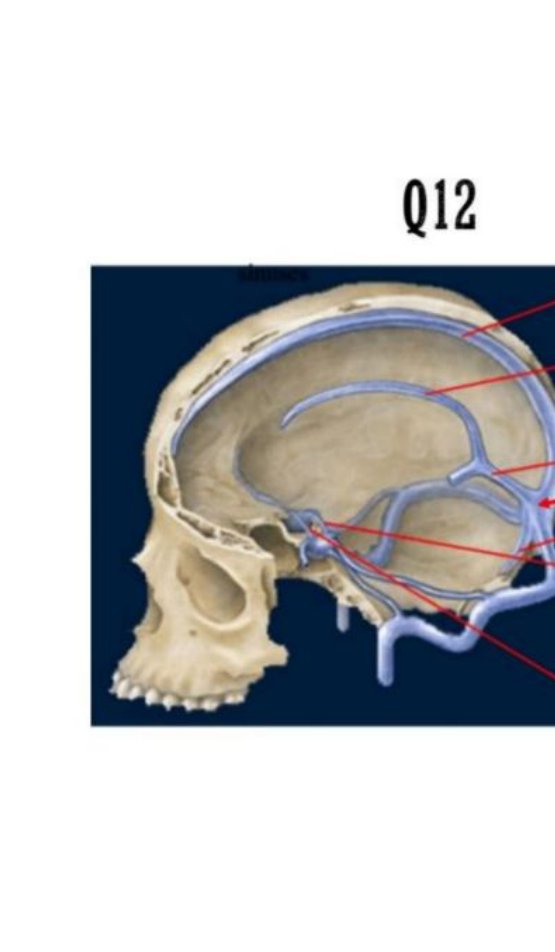
- Two contents of A (superior sagittal sinus): venous blood; cerebrospinal fluid (reabsorbed via arachnoid granulations) (Aponeurosis — Anatomy Question Bank)
Study material on Cerebrospinal Fluid
- CNS PATHOLOGY
- Congenital Hydrocephalus: Prenatal Diagnosis and Surgical Interventions
- Streptococcus pneumoniae: Characteristics, Pathogenesis, and Management
- Haematology Exam 2025: MCQs on Anaemia, Leukaemia & Clotting
- Haematology End of Year 2025 Past Paper — MKU MBML 3200 Questions & Answers
- Department Of Medical Microbiology & Parasit.. MCQs
- HEMATOLOGY EOY 2025
- Aponeurosis — Anatomy Question Bank
- CRUSH COURSE YEAR 3 SEM 1 WORK (Part 1)
- Amebiasis and Pathogenic Free-Living Amebae
- Weekly Year 2: Physiology Exam - May 29, 2026 (Section A: MCQs)
- Weekly Year 2: Physiology Exam - May 15, 2026 (Section A: MCQs)
- Medical Physiology IV (CNS)
Images
Practice questions on Cerebrospinal Fluid
Which of the following items correctly describes the relationship of cerebrospinal fluid pressure to the venous pressure in the superior sagittal sinus?
- A few millimeters higher
- A few millimeters lower
- Equal to
- Twice the value
- One-half the value
Answer: C. CSF pressure is normally maintained at a few millimeters of mercury higher than venous pressure in the superior sagittal sinus. This pressure gradient is essential for CSF drainage through the arachnoid granulations into the venous system. If CSF pressure were lower or equal to venous pressure, proper drainage would not occur. ---
Which of the following items represents the structural basis of the blood-cerebrospinal fluid barrier?
- Tight junctions between the ependymal cells forming the ventricular walls
- Arachnoid villi
- The blood-CSF barrier
- Astrocyte foot processes
- Tight junctions between adjacent endothelial cells of brain capillaries
Answer: C. The blood-CSF barrier is formed by tight junctions between choroid plexus epithelial cells. This barrier controls the movement of substances from blood into CSF. Option E describes the blood-brain barrier, while the other options are not correct structural bases for the blood-CSF barrier. ---
Which of the following parasites can be diagnosed by cerebrospinal fluid biopsy?
- *Trypanosoma brucei gambiense*
- *Plasmodium falciparum*
- *Toxoplasma gondii*
- *Cryptosporidium parvum*
Answer: A. *Trypanosoma brucei gambiense* invades the central nervous system in the late stage of infection, and its presence in CSF can be detected.
Which of the following items correctly describes the relationship of cerebrospinal fluid pressure to the venous pressure in the superior sagittal sinus?
- CSF pressure is normally slightly higher than superior sagittal sinus pressure.
- CSF pressure is normally significantly higher than superior sagittal sinus pressure.
- CSF pressure is normally equal to superior sagittal sinus pressure.
- CSF pressure is normally slightly lower than superior sagittal sinus pressure.
Answer: A. Cerebrospinal fluid (CSF) is absorbed into the venous system, primarily through arachnoid villi that project into the superior sagittal sinus. For absorption to occur, the CSF pressure must be higher than the venous pressure in the sinus.
Which of the following items represents the structural basis of the blood-cerebrospinal fluid barrier?
- Ependymal cells lining the ventricles
- Capillaries of the choroid plexus
- Pia mater
- Arachnoid mater
Answer: B. The blood-cerebrospinal fluid (CSF) barrier is formed by the specialized structure of the capillaries within the choroid plexus. These capillaries are fenestrated but are covered by a layer of epithelial cells (choroid plexus epithelium) that form tight junctions, controlling the passage of substances from the blood into the CSF.
Which of the following items correctly describes the relationship of cerebrospinal fluid pressure to the venous pressure in the superior sagittal sinus?
- CSF pressure is normally slightly higher than superior sagittal sinus pressure.
- CSF pressure is normally significantly higher than superior sagittal sinus pressure.
- CSF pressure is normally equal to superior sagittal sinus pressure.
- CSF pressure is normally slightly lower than superior sagittal sinus pressure.
Answer: A. Cerebrospinal fluid (CSF) is absorbed into the venous system, primarily through arachnoid villi that project into the superior sagittal sinus. For absorption to occur, the CSF pressure must be higher than the venous pressure in the sinus.