Sciatic Nerve
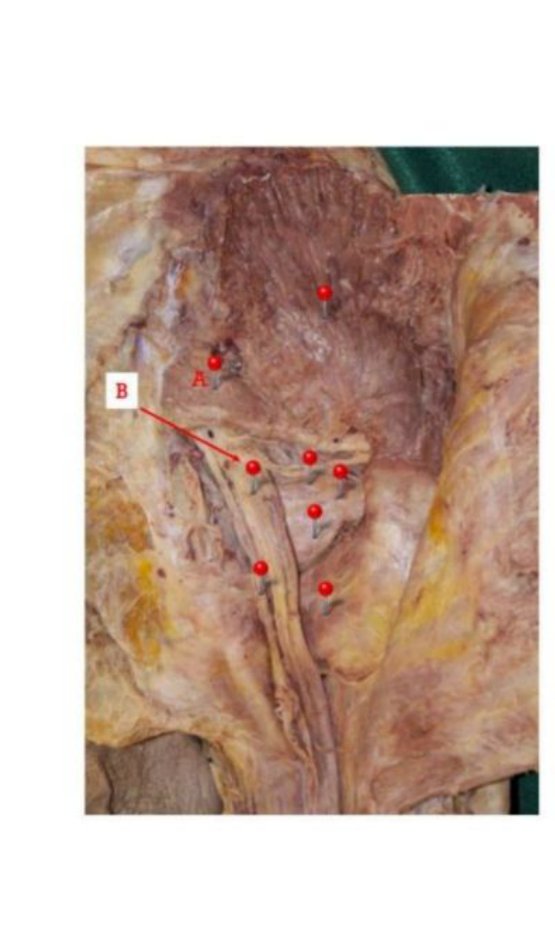
Q3: Name two arterial sources supplying the tagged sciatic nerve
What our notes say
- Q3: Name two arterial sources supplying the tagged sciatic nerve (Aponeurosis — Anatomy Question Bank)
- Longitudinal arterial anastomosis along the sciatic nerve, supplied chiefly by perforating branches of profunda femoris with contributions from the medial circumflex femoral and internal pudendal arteries (Aponeurosis — Anatomy Question Bank)
Study material on Sciatic Nerve
- Aponeurosis — Anatomy Question Bank
- Lower Limb Anatomy MCQ Compilation
- Weekly Year 1: Anatomy Exam - June 12, 2026 (Section A: MCQs)
Images
Practice questions on Sciatic Nerve
The sciatic nerve
- Lies deep to the posterior femoral cutaneous nerve
- Passes down over obturator internus, quadratus femoris and piriformis
- Tibial and common peroneal components separate behind the hip joint
- In the buttock it lies midway between the greater trochanter and pubic tuberosity
- Is derived from L3, 4, 5, S1, 2
Answer: A. The sciatic nerve lies deep (anterior) to the posterior femoral cutaneous nerve in the gluteal region. It emerges below (not over) piriformis, is derived from L4, L5, S1, S2, S3, and typically divides into tibial and common peroneal components in the lower thigh. ---
The surface markings of the sciatic nerve are from
- The ischial tuberosity to the adductor tubercle of the medial femoral condyle
- The posterior superior iliac spine to the apex of the popliteal fossa
- The midpoint of a line between the ischial tuberosity and the greater trochanter to the adductor tubercle of the medial…
- The ischial tuberosity to the apex of the popliteal fossa
- The midpoint of a line between ischial tuberosity and greater trochanter to apex of the popliteal fossa
Answer: A. Sciatic nerve surface marking: from the midpoint between ischial tuberosity and greater trochanter, descending to the apex of the popliteal fossa (where it typically divides). ---
The sciatic nerve:
- Is the largest nerve in the body.
- Is formed from spinal nerve roots L4-S3.
- Supplies the hamstrings and muscles of the anterior and medial thigh.
- All of the above.
Answer: A. The sciatic nerve is the largest nerve in the body. It is formed from spinal nerve roots L4-S3. It primarily supplies the hamstrings and the muscles of the posterior leg and foot; it does NOT supply muscles of the anterior or medial thigh. Those are innervated by the femoral and obturator nerves, respectively.
The sciatic nerve:
- Is the largest nerve in the body.
- Is formed from spinal nerve roots L4-S3.
- Supplies the hamstrings and muscles of the anterior and medial thigh.
- All of the above.
Answer: A. The sciatic nerve is the largest nerve in the body. It is formed from spinal nerve roots L4-S3. It primarily supplies the hamstrings and the muscles of the posterior leg and foot; it does NOT supply muscles of the anterior or medial thigh. Those are innervated by the femoral and obturator nerves, respectively.
The sciatic nerve:
- Is the largest nerve in the body
- Exits the pelvis through the greater sciatic foramen, passing superior to the piriformis muscle
- Is formed solely by the anterior rami of the spinal nerves
- Divides into the tibial and common fibular nerves within the gluteal region
Answer: A. The sciatic nerve is indeed the largest nerve in the body. It exits the pelvis through the greater sciatic foramen, typically passing inferior to the piriformis muscle. It is formed by the posterior divisions of the ventral rami of L4-S3. It divides into the tibial and common fibular nerves in the posterior thigh.
The sciatic nerve:
- Is the largest nerve in the body.
- Is formed by ventral rami of L4-S3.
- Divides into the tibial and common fibular nerves.
- All of the above.
Answer: D. The sciatic nerve is the largest nerve in the body, formed from spinal nerves L4 through S3, and typically divides into the tibial and common fibular nerves in the thigh.