Thyroid Gland
The diffusely enlarged thyroid gland is double to triple in size, which is still difficult to appreciate on physical examination.
What our notes say
- The diffusely enlarged thyroid gland is double to triple in size, which is still difficult to appreciate on physical examination. (Chemical pathology and Endocrine pathology — Past Paper Questions & Answers)
- The thyroid gland produces T3 (active) and T4 (prohormone), regulated by TSH from the pituitary, which is in turn regulated by TRH from the hypothalamus. (ENDOCRINE PATHOLOGY)
- A goiter is an enlargement of the thyroid gland, regardless of its cause. (ENDOCRINE PATHOLOGY)
- Parathyroid Hormone (PTH) is secreted by the parathyroid glands, which are located behind the thyroid gland. (MEDICAL PHYSIOLOGY II ESsays)
- Inflammation of the thyroid gland due to lymphocytic infiltration, causing stored thyroid hormones to be released into the circulation (Internal Medicine 4th Year Endocrinology CAT: 30 MCQs)
- A malignant tumour of the thyroid gland that produces excessive amounts of thyroid hormones (Internal Medicine 4th Year Endocrinology CAT: 30 MCQs)
Study material on Thyroid Gland
- Chemical pathology and Endocrine pathology
- Thyroid Hormone
- Endocrine and Metabolic Pathology MCQs: Practice Questions
- LECTURE 4: Thyroid Hormones
- Review Questions
- ENDOCRINE PATHOLOGY
- Internal Medicine 4th Year Endocrinology CAT: 30 MCQs
- Endocrine and Metabolic Pathology MCQs for Medical Students
- LECTURE 1: Principles of Endocrinology
- Endocrine and Metabolic Pathology MCQs
Images

Practice questions on Thyroid Gland
The two superior and two inferior parathyroid glands are found adjacent to the posterior aspect of the thyroid gland. From which of the following are these parathyroid glands derived in embryologic development?
- Foramen cecum
- Mandibular swellings
- Maxillary processes
- Pharyngeal pouches
- Thyroglossal duct
Answer: D. The fourth pouches give rise to the superior pair of parathyroid glands and the parafollicular C cells within the thyroid; the third pouch gives rise to the inferior parathyroids and the non-lymphoid cells of the thymus. ---
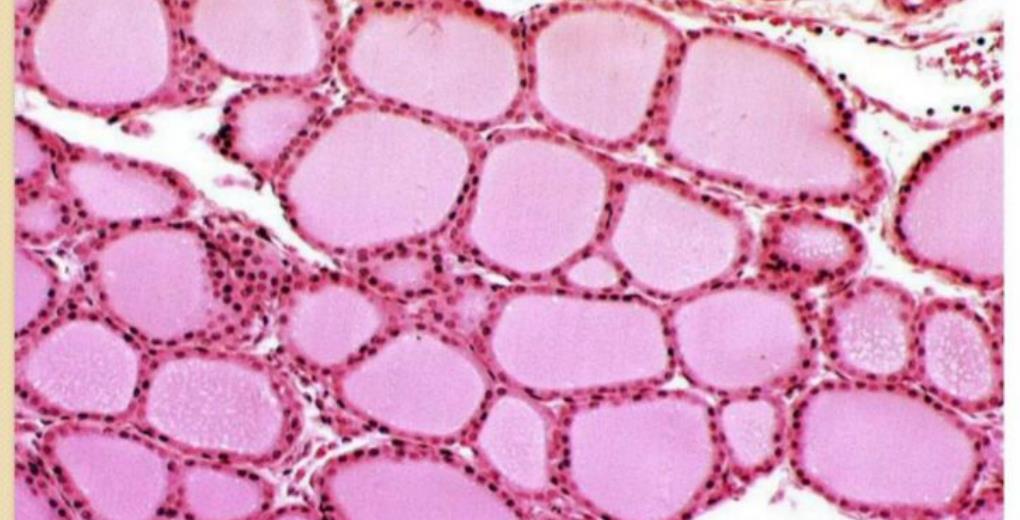
A 35-year-old woman undergoes a thyroidectomy for Graves disease. Histologic examination of the thyroid gland shows follicular epithelial cells that are tall and columnar instead of the normal cuboidal shape. This finding is best explained by which of the following processes?
- Neoplastic transformation
- Hyperplasia with hypertrophy
- Dysplasia
- Metaplasia
- Anaplasia ANSWER: B
Answer: B. In Graves disease, excessive TSH receptor stimulation leads to both increased number (hyperplasia) and increased size (hypertrophy) of follicular cells, causing them to become tall and columnar. This is a physiologic adaptation to hormonal stimulation, not a neoplastic or metaplastic change.
Which of the following regarding thyroxine produced by the thyroid gland is correct?
- Thyroxine has a longer half-life than T3
- Little of thyroxine is converted to inactive reverse T3
- Most of deiodination of thyroxine to T3 is achieved before being secreted
- Thyroxine is the most potent ligand for thyroid hormone receptors
- has a half-life of about 7 days compared to T3's half-life of about 1 day. T4 serves as a prohormone for the more active T3.
Answer: E. T4 (thyroxine) has a half-life of about 7 days compared to T3's half-life of about 1 day. T4 serves as a prohormone for the more active T3. ---
Increasing the uptake of iodine by the thyroid gland and increasing the growth of the thyroid gland are two functions of ---
- TSH-RH
- TSH
- T3
- Thyroglobulin
- LH
Answer: A.