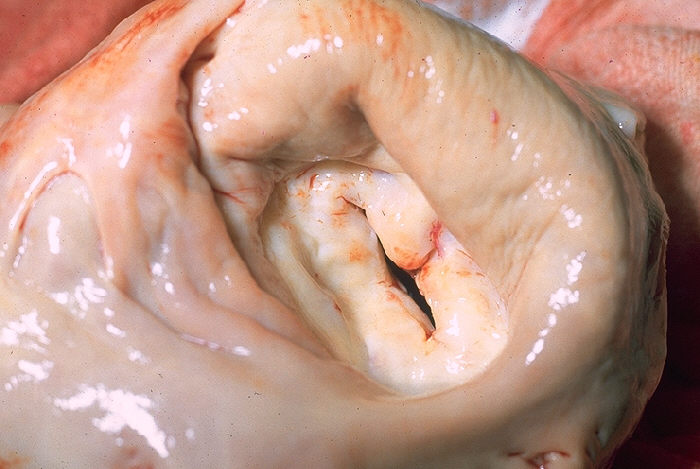
Aortic Regurgitation
Also written as AR.
Topics tested: infective endocarditis, rheumatic fever, cyanotic and acyanotic heart lesions, tetralogy of Fallot, patent ductus arteriosus, coarctation, aortic regurgitation, urinary tract infection, post-streptococcal glomerulonephritis and nephrotic syndrome.
Aortic regurgitation is the diastolic reflux of blood from the aorta into the left ventricle due to incomplete closure of the aortic valve. This leads to left ventricular volume overload, eccentric hypertrophy, and potential heart failure.
Pathophysiology and Presentation
Chronic AR leads to a compensatory increase in stroke volume, resulting in a wide pulse pressure. Patients may remain asymptomatic for years or present with palpitations and dyspnea.
- Wide pulse pressure (elevated systolic, low diastolic)
- Water-hammer (Corrigan) pulse
- Quincke’s sign (capillary pulsations)
Physical Examination and Diagnosis
Clinical diagnosis relies on identifying the characteristic murmur and signs of hyperdynamic circulation.
- Auscultation: High-pitched early diastolic decrescendo murmur at the left sternal border, heard best with the patient leaning forward in expiration.
- Echocardiography: The gold standard to confirm diagnosis, assess valve morphology, and quantify regurgitant volume.
Etiology: Valve and Root Disease
Causes are categorized by whether they primarily affect the valve leaflets or the aortic root.
- Congenital: Bicuspid aortic valve
- Acquired Valve Disease: Rheumatic heart disease and Infective Endocarditis
- Aortic Root Dilation: Marfan syndrome, aortic dissection, and systemic hypertension
- Infections: Tertiary syphilis (aortitis causing vasa vasorum damage)
Severity and Staging
Staging is based on symptoms and ventricular function to determine the timing of surgical intervention.
- Stage A: At risk (e.g., bicuspid valve)
- Stage B: Progressive (mild-to-moderate asymptomatic AR)
- Stage C: Asymptomatic severe AR (divided by preserved or reduced EF)
- Stage D: Symptomatic severe AR
Clinical Management Reasoning
Treatment focuses on reducing afterload and surgical correction when the heart can no longer compensate.
- Vasodilators to reduce regurgitant volume
- Aortic valve replacement (AVR) for symptomatic patients
- Surgery for asymptomatic patients with LV dysfunction (EF < 50%)
Red flags and complications
- Acute pulmonary edema presenting with sudden, severe shortness of breath and pink frothy sputum.
- Cardiogenic shock characterized by low blood pressure, cool extremities, and altered mental status.
- Signs of infective endocarditis such as new murmurs, fever, and embolic phenomena.
- Development of left ventricular failure leading to orthopnea and paroxysmal nocturnal dyspnea.
Management
Management focuses on reducing the workload of the heart and addressing the underlying cause before permanent damage to the left ventricle occurs.
- Identify and treat the primary cause such as syphilis, rheumatic fever, or aortic dissection.
- Use vasodilators like Nifedipine or Enalapril to reduce afterload and improve forward cardiac output.
- Administer Diuretics like Furosemide to relieve symptoms of pulmonary congestion and fluid overload.
- Beta-blockers are generally avoided in acute cases as they may worsen regurgitation by slowing the heart rate.
- Refer for urgent surgical valve replacement if the patient has symptoms or decreasing heart function.
Follow-up and prevention
- Regular echocardiograms to monitor left ventricular size and the severity of the leak.
- Long-term antibiotic prophylaxis for patients with a history of rheumatic fever to prevent recurrence.
- Maintain strict blood pressure control to reduce the strain on the aortic valve.
- Screen first-degree relatives if the cause is identified as a congenital bicuspid aortic valve.
Often confused with
- Graham Steell murmur: Pulmonic regurgitation murmur heard in pulmonary hypertension; distinguished by lack of wide pulse pressure.
- Mitral Stenosis: Both feature diastolic murmurs; however, MS has an opening snap and a low-pitched rumbling sound rather than a high-pitched blow.
- Austin Flint murmur: A functional mid-diastolic rumble in AR that mimics mitral stenosis but lacks an opening snap.
Where results can mislead
- Acute AR: Pulse pressure may be normal and the murmur very short/soft, unlike the classic loud murmur and wide pulse pressure of chronic AR.
- Echocardiogram: Severity may be underestimated if the regurgitant jet is highly eccentric and misses the Doppler sampling volume.
- Left Ventricular Function: Ejection fraction may remain falsely 'normal' due to high stroke volume despite early myocardial failure.
Questions an examiner may ask
- List three peripheral signs of chronic aortic regurgitation and explain their pathophysiology.
- Compare the clinical presentation of acute versus chronic aortic regurgitation.
- What are the indications for surgical valve replacement in an asymptomatic patient?
When to seek help
- Sudden, severe shortness of breath or orthopnea
- New-onset fainting (syncope) or extreme lightheadedness
- Crushing chest pain (angina) during physical activity
- Rapid, irregular heartbeat accompanied by extreme fatigue
Quick questions
What is the classic murmur of Aortic Regurgitation?
It is a high-pitched, decrescendo diastolic murmur heard best at the left sternal border with the patient leaning forward in expiration.
Why does wide pulse pressure occur in this condition?
Increased stroke volume raises systolic pressure, while rapid backflow of blood into the ventricle during diastole significantly lowers diastolic pressure.
What is the significance of Corrigan’s pulse?
Also known as a 'water-hammer' pulse, it indicates a rapidly rising and collapsing arterial pulsation due to high stroke volume and low diastolic pressure.
Aortic Regurgitation
- Causes: Marfan, syphilis, aortic dissection, rheumatic fever, bicuspid AV
- High-pitched early diastolic decrescendo murmur at left sternal border
- Wide pulse pressure — many eponymous signs:
- Corrigan pulse (water-hammer pulse)
- De Musset sign (head bobbing)
Read this in Comprehensive Heart Pathology Notes 🫀
What our notes say
- Topics tested: infective endocarditis, rheumatic fever, cyanotic and acyanotic heart lesions, tetralogy of Fallot, patent ductus arteriosus, coarctation, aortic regurgitation, urinary tract infection, post-streptococcal glomerulonephritis and nephrotic syndrome. (Paediatrics end of 3rd trimester exam (MBPE 4300): 11 January 2022, congenital h)
- Lean the patient forward in expiration to hear the early diastolic murmur of aortic regurgitation. (Heart murmurs)
- | Aortic regurgitation | Early diastolic, left sternal edge | Patient sitting forward, in expiration; wide pulse pressure | (Heart murmurs)
- 1) A flat diaphragm - filters out low pitched sounds and helps identifying high pitched sounds e.g. murmur of aortic regurgitation. (Cardiovascular system examination revised 2012 — Past Paper Questions & Answers)
- o Sit the patient up, leaning forward and listen with the diaphragm for the murmur of aortic regurgitation and for the pericardial friction. (Cardiovascular system examination revised 2012 — Past Paper Questions & Answers)
- The endaortitis of the vasa vasora affects the media of the aorta, leading to buckling of the intimal surface in a 'tree bark' pattern, and aneurysmal dilation, including the aortic root, causing aortic regurgitation. (CARDIOVASCULAR PATHOLOGY — Past Paper Questions & Answers)
Study material on Aortic Regurgitation
- Cardiovascular system examination revised 2012
- 🫀 VALVULAR HEART DISEASE — ULTRA DEEP NOTES
- Heart murmurs
- Paediatrics main exam (MBPE 4300): 24 January 2022, Paper One, 100 MCQs, 2 short essays and 2 long essays
- Paediatrics end of 3rd trimester exam (MBPE 4300): 11 January 2022, congenital heart disease essay and 20 MCQs
- CVS History, Physical Exam & ECG: Master Clinical Assessment
- CVS History & Physical Exam: Symptoms, Chest Pain & Syncope
- High-Yield Clinical Exam Notes: Cranial Nerves, Respiratory, Cardio
Images