Down Syndrome
Down's syndrome is classically linked to atrioventricular septal defect and VSD.
What our notes say
- Down's syndrome is classically linked to atrioventricular septal defect and VSD. (Junior Clerkship in Internal Medicine (MBIM4100) main exam, Paper One: 31 Januar)
- Down syndrome is associated with a small head, not hydrocephalus. (Paediatrics end of fourth year special supplementary exam: August 2019, Paper On)
- The most common cardiac lesion in children with Down syndrome is: (Paediatrics end of second semester exam (MBPE 4300): 4 October 2022, cardiology,)
- AV septal defect is the commonest lesion in Down syndrome. (Paediatrics main exam (MBPE 4300): 24 January 2022, Paper One, 100 MCQs, 2 short)
- Down syndrome is most commonly due to an extra copy of chromosome 21 inherited from the father (Paediatrics end of fourth year main exam: 1 July 2019, Paper One, 99 of 100 MCQs)
- Topics tested: dehydration and shock, neonatal sepsis, pathological jaundice, malnutrition, tetralogy of Fallot, milestones, Down syndrome, meningitis, birth asphyxia, prematurity, breast milk and rickets. (Paediatrics Year 4 MBChB end of semester CAT: triage, newborn care, growth and d)
Study material on Down Syndrome
- Genetics & Disease: Muscular Dystrophy, CF, Marfan, Diabetes, Cancer
- Paediatrics end of fourth year special supplementary exam: August 2019, Paper One, 87 of 100 MCQs
- Paediatrics end of fourth year main exam: 1 July 2019, Paper One, 99 of 100 MCQs and essays
- Mbchb Cat - Genetics Answer Key
- cat 2 2014 — Source Paper Awaiting Edit
- Clinical Genetics: Master Mendelian Disorders & Molecular Basis
- Genetic Disorders Pathology Crash Course: Exam Revision Notes
- Mbchb Cat - Genetics Answer Key MCQs
- Paediatrics Year 4 MBChB end of semester CAT: triage, newborn care, growth and development, 30 MCQs and 5 short answers
- Genetic Disorders CAT: Key Terms & Inheritance Patterns Explained
- Genetic Disorders MCQs Examination (Part 2)
- COMPLEX MULTIGENIC AND CYTOGENETIC DISORDERS - 50 MCQs
- Complex Multigenic and Cytogenetic Disorders MCQs
- MCQ: Genetic Disorders Year 3 End Year
- Pathology by Dr. Irungu
Images
Practice questions on Down Syndrome
What percentage of Down syndrome cases are caused by trisomy 21?
- 75%
- 85%
- 95%
- 99%
- Occurs only after chronic exposure
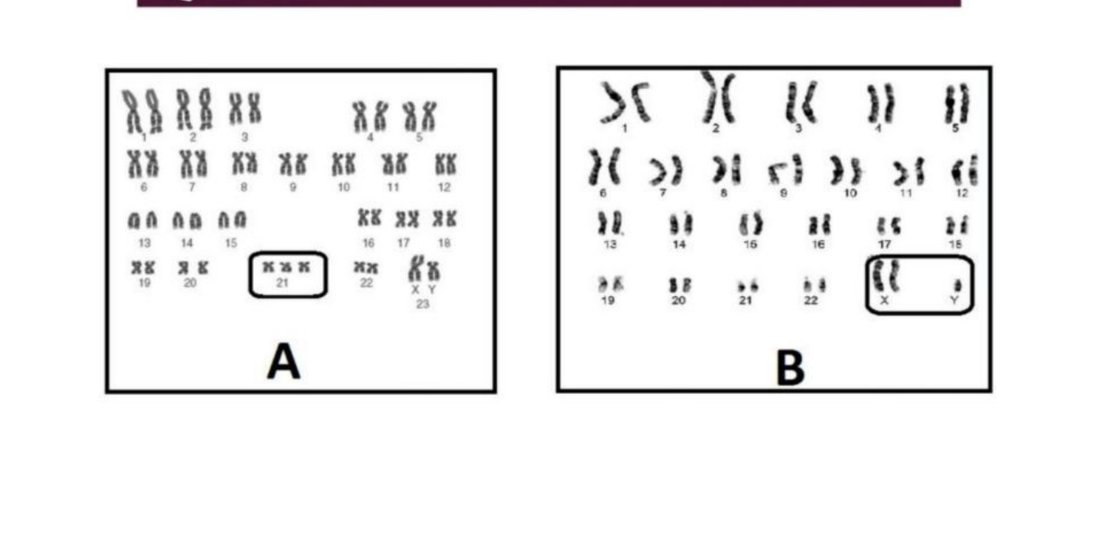
Answer: C. About 95% of affected persons with Down syndrome have trisomy 21, with a chromosome count of 47, most commonly caused by meiotic nondisjunction. ---
What is the maternal age-related incidence of Down syndrome in women older than 45 years?
- 1 in 100
- 1 in 50
- 1 in 25
- 1 in 10
- Limited to a single tissue compartment
Answer: C. Down syndrome occurs in 1 in 1550 live births in women younger than 20 years but increases dramatically to 1 in 25 live births in women older than 45 years. ---
In what percentage of Down syndrome cases is the extra chromosome of maternal origin?
- 50%
- 75%
- 85%
- 95%
- Primarily an incidental laboratory finding
Answer: D. In 95% of Down syndrome cases, the extra chromosome is of maternal origin, supporting that meiotic nondisjunction occurs primarily in the ovum. ---
What percentage of Down syndrome cases result from translocation?
- 1%
- 4%
- 10%
- 15%
- Usually mediated by non-specific mechanisms
Answer: B. In about 4% of all patients with trisomy 21, the extra chromosomal material is present as a translocation of the long arm of chromosome 21 to chromosome 22 or 14. ---
What percentage of Down syndrome patients are mosaics?
- 1%
- 4%
- 10%
- 15%
- Mostly unchanged in early disease
Answer: A. Approximately 1% of patients with trisomy 21 are mosaics, usually having a mixture of 46- and 47-chromosome cells resulting from mitotic nondisjunction during embryogenesis. ---
What percentage of Down syndrome patients have congenital heart disease?
- 20%
- 30%
- 40%
- 60%
- Reduced by routine feedback control
Answer: C. Approximately 40% of Down syndrome patients have congenital heart disease, most commonly endocardial cushion defects including atrial septal defects and ventricular septal defects. ---