Fractures
o a chest free from pain, tenderness, lesions, and masses o The wall should be firm with no indication of rib fractures or abscesses o Trachea will be midline; a deviated trachea is abnormal.
What our notes say
- o a chest free from pain, tenderness, lesions, and masses o The wall should be firm with no indication of rib fractures or abscesses o Trachea will be midline; a deviated trachea is abnormal. (Examination of Respiratory system — Past Paper Questions & Answers)
- Provoked: recent surgery (hip and knee, abdominal, pelvic), trauma or fracture, immobility (bed rest, long travel, stroke), hospitalisation, cancer and chemotherapy, pregnancy and the postpartum period, oestrogen (combined pill, HRT), central venous catheter. (DVT and Venous Thromboembolism (with Pulmonary Embolism))
- Distant metastases: bone (pain, pathological fracture, hypercalcaemia), brain (headache, seizures, focal signs), liver, adrenals. (Lung Cancer)
- Fetal injury: fractures, brachial plexus injury, intracranial haemorrhage (Reproductive Health End of Trimester 2 CAT (MBOG 4223): labour and cord prolapse)
- Last resort options: deliberate fracture of the clavicle, cephalic replacement (Zavanelli manoeuvre) followed by caesarean section, or symphysiotomy. (Junior Clerkship in Reproductive Health (MBOG 4200): end of year examination, 4 )
- A bisphosphonate that inhibits osteoclasts and reduces fracture risk. (Clinical Pharmacology I (MBPL 4400) main exam: 25 January 2023)
Study material on Fractures
- CNS Trauma Neuropathology: Fractures, Concussion & CTE
- Bone & Joint Pathology: Basic Structure, Cells, and Fractures
- Bone & Soft Tissue Pathology: Cases, Tumors, & Answers
- Aponeurosis — Anatomy Question Bank
- Examination of Respiratory system
- General & Systemic Pathology SAQ Paper II — 15 July 2025 (MBPA 3500, MKU Year 3, With Answers)
- White Cell Disorders — Must-Know Notes
- CNS PATHOLOGY
- Eoy paper 2 gen systemic Patho 2025
Images
Practice questions on Fractures
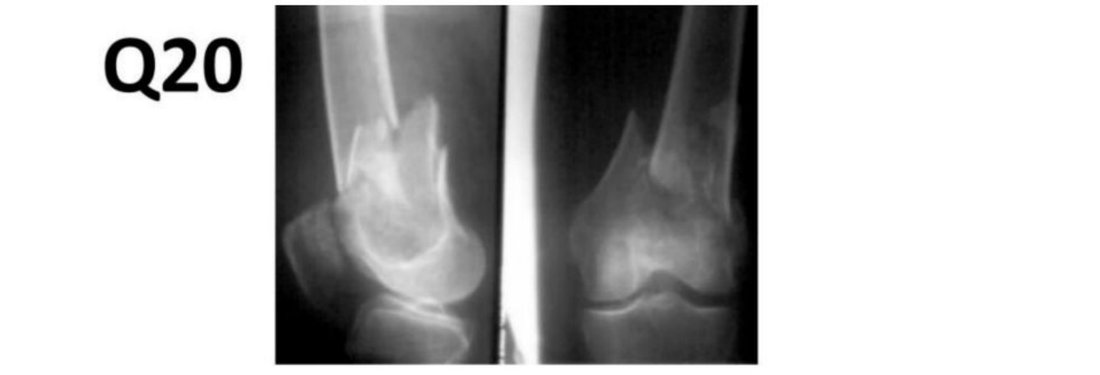
A 30-year-old man sustains a left femoral fracture in a skiing accident, and his leg is placed in a plaster cast. After the leg has been immobilized for several weeks, the diameter of the left calf has decreased. This change is most likely to result from which of the following alterations in the calf muscles?
- Aplasia
- Hypoplasia
- Atrophy
- Dystrophy
- Hyalinosis ANSWER: C
Answer: C. Reduced workload causes shrinkage of cell size because of loss of cell substance, a process called atrophy. Aplasia refers to lack of embryonic development; hypoplasia describes poor or subnormal development. ---
An 83-year-old woman undergoes open reduction of a radial fracture and receives heparin prophylaxis. One week later platelets drop from 209,000 to 101,000. She suddenly cannot move her right arm. Most likely cause?
- Hypersplenism
- Immune thrombocytopenic purpura
- Disseminated intravascular coagulation
- Drug-induced thrombocytopenia
Answer: D. Platelet drop 5–14 days after heparin + thrombotic stroke (not bleeding) = heparin-induced thrombocytopenia (HIT). Antibodies to platelet factor 4-heparin complex cause paradoxical thrombosis — the 'white clot' syndrome. ---
Fat embolism syndrome typically develops within what time frame after long bone fracture?
- Immediately within 1–2 hours of injury
- Within 24–72 hours after injury
- Between 1 and 2 weeks after injury
- More than 4 weeks after the initial trauma
Answer: B. Fat embolism syndrome (petechiae, neurologic symptoms, respiratory failure) typically develops 24–72 hours after massive trauma or long bone fracture. The mechanism involves mechanical obstruction plus toxic fatty acid release causing endothelial damage. ---