Pulmonary Embolism
Also written as PE.
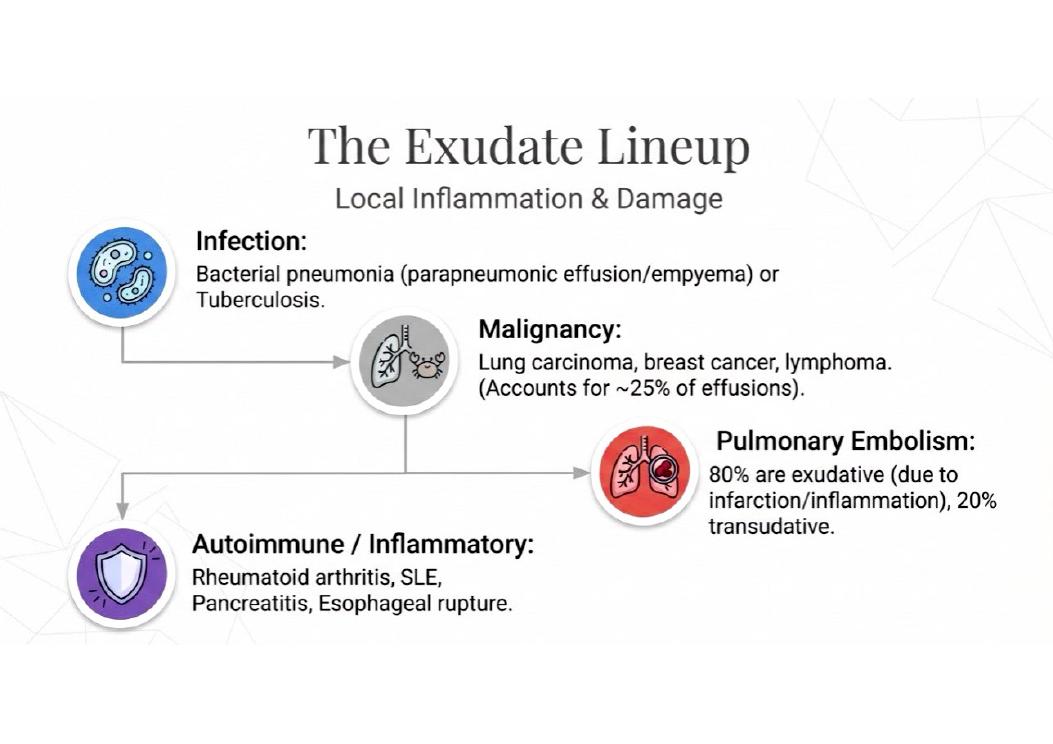
Effusions in pulmonary embolism may be either type, and are often blood-stained.
What our notes say
- Effusions in pulmonary embolism may be either type, and are often blood-stained. (Internal Medicine Respiratory CAT 1: 30 MCQs and 5 short answer questions)
- The target INR is 2 to 3 (aim 2.5) for at least 3 months in a provoked pulmonary embolism. (Internal Medicine (MBIM 4100) main exam, Paper One: 3 July 2019)
- The Wells score is for pulmonary embolism and deep vein thrombosis. (Respiratory Medicine Question Bank: 15 Clinical MCQs)
- BNP is raised in kidney failure, atrial fibrillation, older age and pulmonary embolism, and lower in obesity. (Heart failure: which tests and why)
- Deep Vein Thrombosis and Venous Thromboembolism (with Pulmonary Embolism) — Year 4 Internal Medicine Notes (DVT and Venous Thromboembolism (with Pulmonary Embolism))
- Pulmonary embolism (PE): a clot (usually from a leg DVT) lodges in the pulmonary arteries. (DVT and Venous Thromboembolism (with Pulmonary Embolism))
Study material on Pulmonary Embolism
- DVT and Venous Thromboembolism (with Pulmonary Embolism)
- Cat. Pathology: Acute Inflammation, Mediators & Pulmonary Embolism
- Examination of Respiratory system
- Junior Clerkship in Internal Medicine (MBIM4100) main exam, Paper One: 31 January 2024
- Cardiovascular system examination revised 2012
- Respiratory Medicine Question Bank: 15 Clinical MCQs
- Lung Pathology — Must-Know
- Internal Medicine Respiratory CAT 1: 30 MCQs and 5 short answer questions
- Internal Medicine (MBIM 4100) main exam, Paper One: 3 July 2019
- General Pathology Q&A
- Respiratory System Pathology 1A — Practice Questions
Images
Practice questions on Pulmonary Embolism
In pulmonary embolism, infarction occurs in only about 10% of cases because
- Most emboli are too small to cause significant obstruction
- The lung has dual blood supply from pulmonary and bronchial arteries
- Fibrinolysis rapidly resolves most emboli before infarction
- Collateral circulation from adjacent lung segments prevents necrosis
Answer: B. The lung is protected from infarction by its dual blood supply: pulmonary arteries, bronchial arteries, and direct oxygenation from alveolar air. Infarction only occurs when this is compromised. ---
Which statement correctly distinguishes superficial varicose veins from deep vein thrombosis regarding pulmonary embolism risk?
- Both carry equal PE risk as thrombus can propagate freely between the systems
- DVT is the major source of PE; embolism from superficial varicose veins is very rare
- Varicose veins carry higher embolism risk due to greater peripheral venous pressure
- Neither causes PE without a concurrent cardiac septal defect
Answer: B. Embolism from superficial varicose veins is very rare. DVT — particularly in popliteal, femoral, and iliac veins — is the major source of potentially fatal pulmonary embolism. ---