Physical Examination
On physical examination, a person with a history of substance misuse has piloerection, dilated pupils, rhinorrhoea and is yawning frequently.
Physical Examination
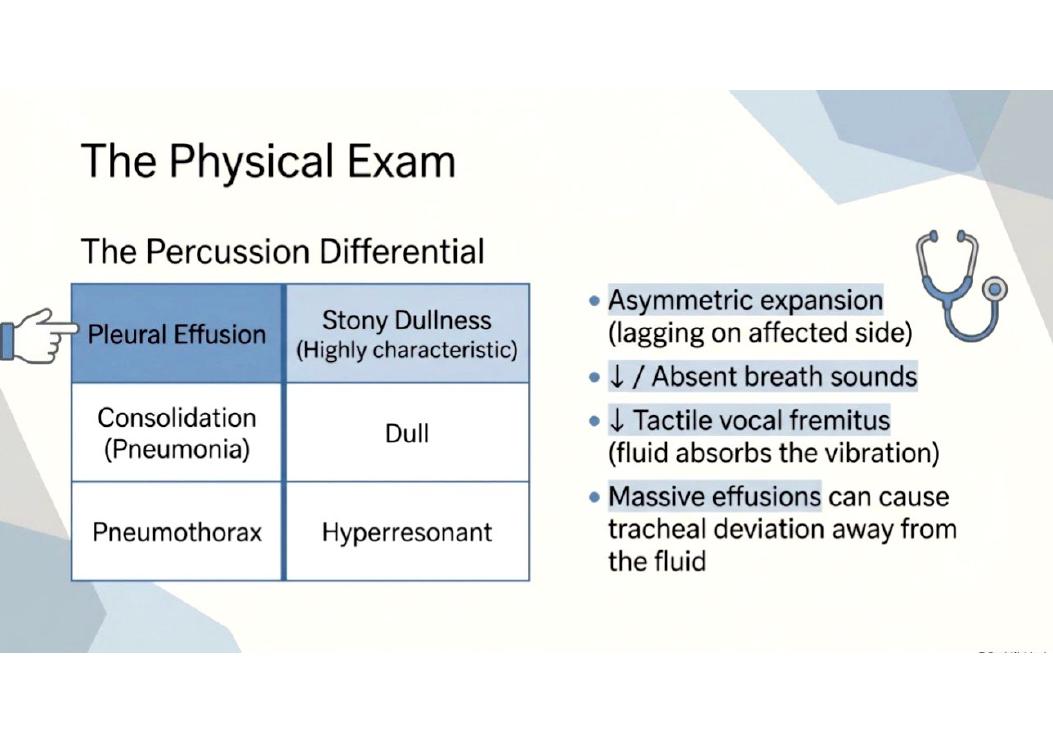
- Asymmetric expansion — lagging on the affected side
- Stony dullness — highly characteristic
- Absent / reduced breath sounds
- Reduced tactile vocal fremitus (fluid absorbs vibration)
- Bronchial breathing / aegophony at the upper fluid border
Read this in Pleural Effusion: Light's Criteria, Fluid Analysis and Management
Physical examination
- Depends on size; vital signs often normal in small ones.
- ↓ chest movement on the affected side
- Trachea shifted away if large
- Hyper-resonant percussion
- Breath sounds reduced or absent
Read this in Pneumothorax: Classification, Clinical Features and Emergency Management
What our notes say
- On physical examination, a person with a history of substance misuse has piloerection, dilated pupils, rhinorrhoea and is yawning frequently. (Psychiatry Year 6 CAT: June 2023, psychopathology, psychosis, mood and child psy)
- On physical examination, you notice that a person with a history of substance misuse has piloerection, dilated pupils, rhinorrhoea and is yawning frequently. (Psychiatry Year 6 CAT: October 2023, violence, defence mechanisms, hallucination)
- On physical examination there are crackles at the right lung base. (Hematology MCQs)
- The knowledge of the position of the heart, its chambers and its valves within the chest is the key to understanding the physical examination of the heart, the electrocardiogram, the chest X-ray and the echocardiogram. (Cardiovascular system examination revised 2012 — Past Paper Questions & Answers)
- On physical examination she is afebrile and normotensive. (Chemical pathology and Endocrine pathology — Past Paper Questions & Answers)
- On physical examination her temperature is 37.5°C, pulse 108/minute, respiratory rate 24/minute, and blood pressure 145/85 mm Hg. (Chemical pathology and Endocrine pathology — Past Paper Questions & Answers)
Study material on Physical Examination
- Paediatric History Taking and Physical Examination
- Gastrointestinal and liver
- hematopathology
- Chemical pathology and Endocrine pathology
- renal pathology
- Respiratory system pathology mcqs
- Female system
- CNS PATHOLOGY
- CARDIOVASCULAR PATHOLOGY
- Breast mcqs
- Male reproductive system — Past Paper Questions & Answers
- Male Reproductive System — Clinical MCQs
- Artherosclerosis — Past Paper Questions & Answers
- Cell injury mcqs — Past Paper Questions & Answers
- clinical pathology — Past Paper Questions & Answers
- CLINICAL CHEMISTRY MCQS REVISION — Past Paper Questions & Answers
Images
Practice questions on Physical Examination
A 68-year-old woman has survived multiple episodes of pulmonary thromboembolism during the past three months. On physical examination there are no abnormal findings. Which of the following is the most likely underlying condition leading to this patient's recurrent pulmonary thromboembolism?
- Micronodular cirrhosis of the liver
- Adenocarcinoma of the pancreas
- Thrombocytopenia
- Familial hypercholesterolemia
- Mitral valve endocarditis F. Type II diabetes mellitus
Answer: B. The recurrent episodes suggest a hypercoagulable state, and carcinomas can do this (Trousseau syndrome) by releasing substances that act as thromboplastins. Even a small carcinoma difficult to detect can produce thromboplastic substances as a paraneoplastic phenomenon. ---
A 57-year-old woman has experienced episodes of altered mental status for the past month. On physical examination, she has bilateral carotid artery bruits. She is given folic acid supplementation. Which of the following laboratory test findings is she most likely to have?
- Factor V Leiden mutation
- Factor VIII deficiency
- Increased carcinoembryonic antigen
- Homocysteinemia
- Increased HDL cholesterol
Answer: D. An elevated plasma homocysteine level is a risk for atherosclerosis as well as thrombosis. Her findings point to transient ischemic attacks (TIAs) with risk for stroke. The carotid bruits represent arterial narrowing as the result of atherosclerosis. ---
A 22-year-old woman has a congenital anemia. She has required multiple transfusions of red blood cells for many years. She now has a darker bronze colour to her skin on physical examination. Which of the following microscopic findings would most likely present in her liver?
- Steatosis in hepatocytes
- Bilirubin in canaliculi
- Hemosiderin in hepatocytes
- Glycogen in hepatocytes
- Amyloid in portal triads
Answer: C. There is 250 mg of iron in each unit of blood. The body has no mechanism for getting rid of excess iron. A small amount of iron is lost with normal desquamation of epithelia, and menstruating women will lose a bit more. The excess iron becomes storage iron, or hemosiderin. Over time, hemosiderosis involves more and more tissues of the body, particularly the liver, but also skin (bronze colour), heart (with heart fail
A 45-year-old man has a traumatic injury to his forearm and incurs extensive blood loss. On physical examination in the emergency department his blood pressure is 70/30 mm Hg. Which of the following cellular changes is most likely to represent irreversible cellular injury as a result of this injury?
- Epithelial dysplasia
- Cytoplasmic fatty metamorphosis
- Nuclear pyknosis
- Atrophy
- Anaerobic glycolysis F. Autophagocytosis
Answer: C. The hypotension leads to diminished tissue perfusion with ischemic injury. Nuclear chromatin clumping is reversible, but nuclear pyknosis is not. ---
a 27-year-old man has complained of continuing 'jock itch' for the past year. On physical examination there are small whitish scaling patches on the skin of his perineum. A scraping from the lesion shows Trichophyton rubrum organisms. Which of the following lesions is he most likely to develop?
- Condyloma acuminatum
- Chancre
- Bowen disease
- Angiokeratoma
- Lichen simplex chronicus
Answer: E. The chronic rubbing and scratching from this dermatophyte infection can result in epidermal hyperplasia and chronic inflammation. ---
A healthy 17-year-old adolescent has a routine check of his health status. On physical examination pearly penile papules are noted at the edge of the glans penis. He is noted to be circumcised. There is no erythema or urethral discharge. He is not sexually active. Which of the following is the most likely diagnosis?
- Bowen disease
- Human papillomavirus infection
- Normal variation
- Balanitis with Staphylococcus aureus
- Phimosis
Answer: C. This is really a normal variation, but some patients may be concerned when they notice that other men do not have them. Patients do notice such minor things, and it is helpful to know the range of potential variations in body parts. ---