Ascites
Malignancy is suggested by solid areas, thick septa, vascularity, bilaterality and ascites.
Ascites
- Abnormal excessive accumulation of fluid in peritoneal cavity
- Most common of the three major complications of cirrhosis (ascites, hepatic encephalopathy, bleeding varices)
- One of 5 parameters of Child-Pugh score — most widely used system for liver function assessment
- Presence of ascites associated with poorer survival in cirrhosis: 1-year survival 85%; 5-year survival 56% ; and in hepatocellular carcinoma
- Pathophysiology — Four Reinforcing Mechanisms:
Read this in GASTROINTESTINAL PATHOLOGY (Part 2)
What our notes say
- Malignancy is suggested by solid areas, thick septa, vascularity, bilaterality and ascites. (Year 4 Gynaecology CAT (MBOG 4212): 13 December 2019)
- Oedema is periorbital in the morning, then generalised with ascites, pleural effusion and scrotal swelling. (Paediatrics and Child Health end of semester examination (MBPE): 10 January 2023)
- The score uses bilirubin, albumin, INR, ascites and encephalopathy, so a high-risk score (class C, 10 or more) is possible without encephalopathy. (Internal Medicine CAT 1 (MBChB 4), 2022: liver, pancreas and bone marrow, 30 MCQ)
- Acute bacterial peritonitis is a common complication in patients with ascites (Paediatrics main exam (MBPE 4300): 24 January 2022, Paper One, 100 MCQs, 2 short)
- Fluid passing from the abdomen (ascites, peritoneal dialysis) → transudate. (Pleural Effusion)
- Benign: unilocular, thin wall, smooth regular margins, anechoic content, no solid area, no ascites, unilateral, and little or peripheral blood flow. (Year 4 Gynaecology CAT (MBOG 4212): 30 November 2018)
Study material on Ascites
- High-Yield Clinical Exam Notes: Cranial Nerves, Respiratory, Cardio
- Liver Histology & Physiology
- Liver Histology & Physiology
- GASTROINTESTINAL PATHOLOGY (Part 2)
- Junior Clerkship in Internal Medicine (MBIM4100) main exam, Paper One: 31 January 2024
- Cranial Nerves, Eye Exam & Vital Signs: MBChB Clinical Revision
- Internal Medicine CAT 1 (MBIM 6112), 2019/2020: gastroenterology and hepatology, 30 MCQs and 4 short answers
- Gastrointestinal System: Symptoms, Diseases, & VINDICATE Guide
- Paediatrics end of second semester exam (MBPE 4300): 4 October 2022, cardiology, hepatology and gastroenterology, 47 of 50 MCQs
- Endocrinology and Gastroenterology Question Bank: 12 Clinical MCQs
- Liver Histology, Physiology and Pathology — Practice Questions
- Liver Histology, Physiology and Pathology — Practice Questions
- Liver Histology, Physiology and Pathology — Practice Questions
- Liver Histology, Physiology and Pathology — Practice Questions
- Liver Histology, Physiology and Pathology — Practice Questions
- Liver Histology, Physiology and Pathology — Practice Questions
Images
Practice questions on Ascites
A 58-year-old man has ascites, a cirrhotic liver on CT, and a globally enlarged heart on CXR. BP and HR are normal. Most likely cardiovascular condition?
- Severe occlusive coronary atherosclerosis
- Lymphocytic myocarditis
- Myocardial amyloid deposition
- Dilated cardiomyopathy
Answer: D. Cirrhosis + globally dilated heart without hypertension or ischemic features = alcoholic dilated cardiomyopathy. Alcohol is a direct myocardial toxin causing diffuse dilation. ---
A 50-year-old female with a history of chronic hepatitis C develops ascites and esophageal varices. Liver biopsy shows micronodular cirrhosis. What is the most likely complication leading to this advanced liver disease?
- Hepatitis B co-infection
- Alcoholic liver disease
- Non-alcoholic fatty liver disease (NAFLD)
- Hepatocellular carcinoma
Answer: A. While chronic Hepatitis C is a direct cause of cirrhosis, co-infection with Hepatitis B can accelerate the progression to cirrhosis and hepatocellular carcinoma. In the context of already advanced disease, it's a significant factor that would have contributed to the severity and progression. ---
A woman develops chylous ascites after surgery for ovarian cancer. What does the presence of chylous (milky) fluid specifically indicate?
- Haemoperitoneum from intraoperative injury to mesenteric vessels during surgery
- Cirrhotic ascites with elevated triglyceride content from hepatic lipid metabolism dysfunction
- Bowel perforation with leakage of chyme and fat into the peritoneal cavity
- Rupture of dilated lymphatics from obstruction allowing lymph to accumulate in the abdomen
Answer: D. Chylous ascites results from rupture of dilated lymphatics caused by obstruction (tumour, surgery) — allowing lymph to accumulate in the peritoneal cavity. The milky appearance reflects its high lipid content. ---
A 38-year-old woman presents with pelvic mass and ascites. CA-125 is elevated. Which condition is most likely?
- Ovarian carcinoma
- Endometriosis
- Hydrosalpinx
- Adenomyosis
- Leiomyoma ✅ Answer: A
Answer: A. Elevated CA-125, a pelvic mass, and ascites are highly suggestive features of ovarian carcinoma, especially in a postmenopausal woman.
A patient with liver cirrhosis and portal hypertension may experience ascites due to:
- Decreased capillary hydrostatic pressure in the peritoneal cavity.
- Increased plasma albumin synthesis by the liver.
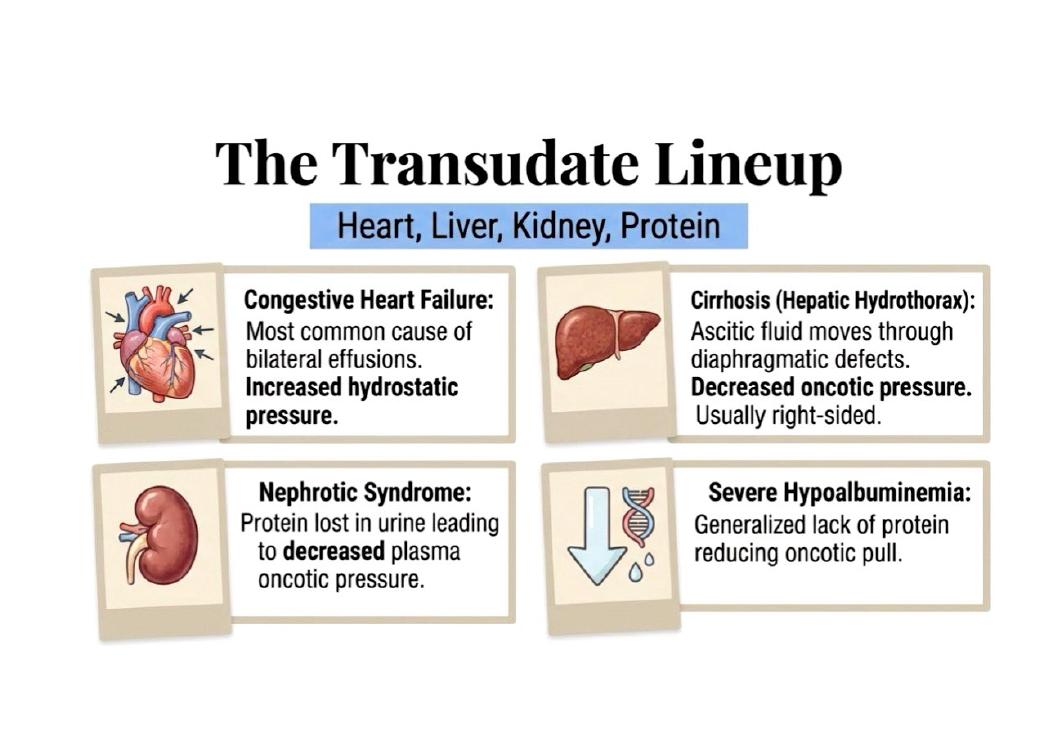
- Increased capillary hydrostatic pressure and decreased plasma oncotic pressure.
- Excessive absorption of fluid from the peritoneal cavity.
Answer: C. Ascites (fluid accumulation in the peritoneal cavity) in liver cirrhosis is primarily caused by two factors: increased capillary hydrostatic pressure due to portal hypertension, which pushes fluid out of the splanchnic circulation, and decreased plasma oncotic pressure due to impaired albumin synthesis by the diseased liver, which reduces the osmotic pull of fluid back into the capillaries. This leads to net fluid mo
A 38-year-old woman presents with pelvic mass and ascites. CA-125 is elevated. Which condition is most likely? CA-125 is the classic (though nonspecific) ovarian cancer marker. ---
- Ovarian carcinoma
- Endometriosis
- Leiomyoma
- Hydrosalpinx
- Adenomyosis
Answer: A.