Congestive Heart Failure
Also written as CHF.
The following statements are true about congestive heart failure in young infants:
CONGESTIVE HEART FAILURE (CHF)
- Definition: Heart cannot generate sufficient output to meet metabolic demands — OR can only do so at elevated filling pressures
- Epidemiology: ~5 million affected in USA; 1 million hospitalizations/year; 300,000 deaths/year
- Systolic dysfunction (most common) — ischemic heart disease, hypertension
- Diastolic dysfunction — LV hypertrophy, fibrosis, amyloid, constrictive pericarditis; more common in elderly, diabetics, women; accounts for 40–60% of CHF
- High-output failure — hyperthyroidism, anemia
Read this in Heart Disease — Must Knows
CONGESTIVE HEART FAILURE (CHF)
- Definition: Heart cannot generate sufficient output to meet metabolic demands — OR can only do so at elevated filling pressures
- Epidemiology: ~5 million affected in USA; 1 million hospitalizations/year; 300,000 deaths/year
- Systolic dysfunction (most common) — ischemic heart disease, hypertension
- Diastolic dysfunction — LV hypertrophy, fibrosis, amyloid, constrictive pericarditis; more common in elderly, diabetics, women; accounts for 40–60% of CHF
- High-output failure — hyperthyroidism, anemia
Read this in Heart Disease: Must Knows
Congestive Heart Failure (CHF)
- Combined left and right heart failure
Read this in CARDIOVASCULAR PATHOLOGY
What our notes say
- The following statements are true about congestive heart failure in young infants: (Paediatrics Year 6 MBChB end of semester CAT: clinical case MCQs, 29 of 30 quest)
- • The most common conditions associated with coarse crackles are congestive heart failure and pneumonia (Examination of Respiratory system — Past Paper Questions & Answers)
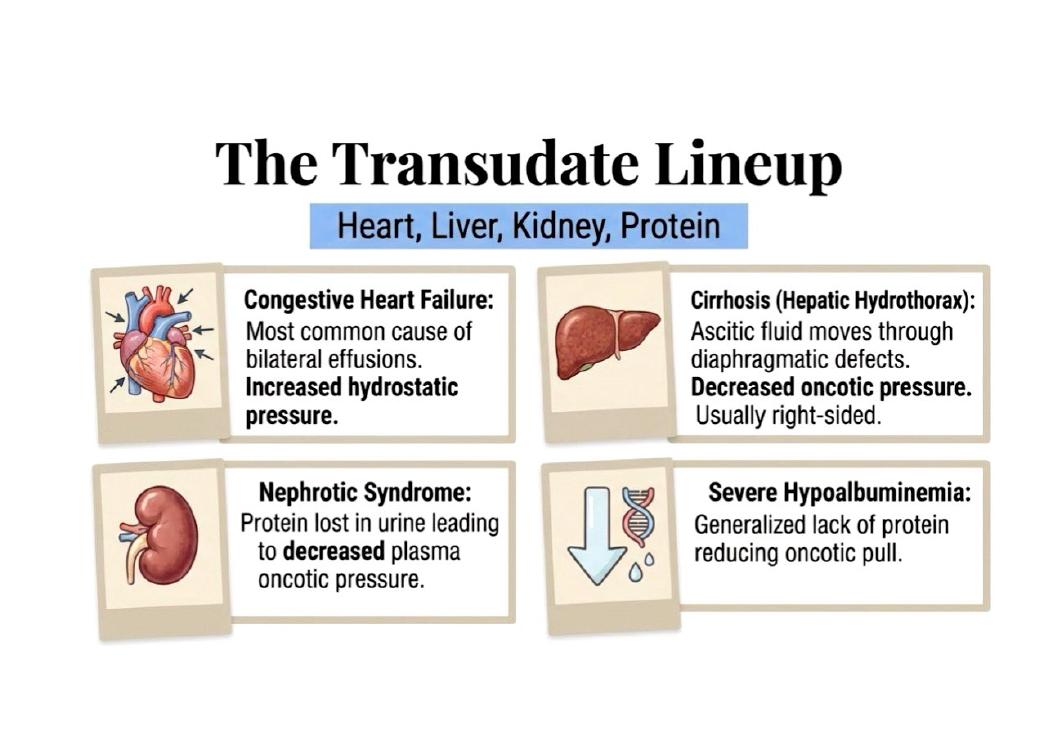
- Congestive heart failure — commonest cause of bilateral effusions; ↑ hydrostatic pressure (Pleural Effusion: Light's Criteria, Fluid Analysis and Management)
- g) Heart conditions - cute episode of congestive heart failure h) serious allergic reaction (anaphylaxis), (Examination of Respiratory system — Past Paper Questions & Answers)
- The baby may first become symptomatic when the pulmonary arteries dilate fully after the first month of life and the shunting from left-to-right increases to promote congestive heart failure. (CARDIOVASCULAR PATHOLOGY — Past Paper Questions & Answers)
- A 66-year-old man has had congestive heart failure with increasing pulmonary congestion and edema for the past year. (CARDIOVASCULAR PATHOLOGY — Past Paper Questions & Answers)
Study material on Congestive Heart Failure
- Heart Disease — Must Knows
- Heart Disease: Must Knows
- CARDIOVASCULAR PATHOLOGY
- Internal Medicine Respiratory CAT 1: 30 MCQs and 5 short answer questions
- General Pathology MCQs: Fixatives, FNA, Endocrine & ARDS
- Lung Pathology — Must-Know
- Respiratory System Pathology 1A
- Examination of Respiratory system
Images

Practice questions on Congestive Heart Failure
A 44-year-old man has had congestive heart failure for 2 years. His serum ferritin is markedly elevated. His CBC shows WBC count 6300/microliter, Hgb 7.8 g/dL, Hct 22.6%, MCV 69 fL, and platelet count 177,000/microliter. A hemoglobin electrophoresis reveals 2% Hgb A, 8% Hgb A2, and 90% Hgb F. Which of the following hematologic conditions is he most likely to have?
- Beta thalassemia major
- Iron deficiency anemia
- Alpha thalassemia trait
- Sickle cell anemia
Answer: A. The patient's microcytic anemia (MCV 69 fL), elevated ferritin (indicating iron overload, common in transfused thalassemia patients), very high Hb F, and significantly reduced Hb A are diagnostic features of Beta Thalassemia Major (Cooley's anemia). Congestive heart failure can be a complication of iron overload.
A 44-year-old man has had congestive heart failure for 2 years. His serum ferritin is markedly elevated. His CBC shows WBC count 6300/microliter, Hgb 7.8 g/dL, Hct 22.6%, MCV 69 fL, and platelet count 177,000/microliter. A hemoglobin electrophoresis reveals 2% Hgb A, 8% Hgb A2, and 90% Hgb F. Which of the following hematologic conditions is he most likely to have?
- Beta thalassemia major
- Alpha thalassemia minor
- Iron deficiency anemia
- Myelodysplastic syndrome
Answer: A. The patient has microcytic anemia (low MCV), elevated ferritin (suggesting iron overload, common in chronic transfusions or ineffective erythropoiesis), and a high percentage of fetal hemoglobin (Hb F) with very little adult hemoglobin (Hb A). This pattern is highly characteristic of Beta thalassemia major, where the production of beta-globin chains is severely impaired, leading to ineffective erythropoiesis and a co
A 44-year-old man has had congestive heart failure for 2 years. His serum ferritin is markedly elevated. His CBC shows WBC count 6300/microliter, Hgb 7.8 g/dL, Hct 22.6%, MCV 69 fL, and platelet count 177,000/microliter. A hemoglobin electrophoresis reveals 2% Hgb A, 8% Hgb A2, and 90% Hgb F. Which of the following hematologic conditions is he most likely to have?
- Beta thalassemia major
- Alpha thalassemia trait
- Sideroblastic anemia
- Iron deficiency anemia
Answer: A. The elevated Hgb F (90%) along with low MCV (69 fL) and severe anemia in a patient with chronic heart failure and elevated ferritin is highly suggestive of beta-thalassemia major. The elevated ferritin is due to increased iron absorption, common in thalassemia, and potential iron overload from repeated transfusions (though not explicitly mentioned, it's a consideration in severe cases). The low Hgb A2 is also consist
A 44-year-old man has had congestive heart failure for 2 years. His serum ferritin is markedly elevated. His CBC shows WBC count 6300/microliter, Hgb 7.8 g/dL, Hct 22.6%, MCV 69 fL, and platelet count 177,000/microliter. A hemoglobin electrophoresis reveals 2% Hgb A, 8% Hgb A2, and 90% Hgb F. Which of the following hematologic conditions is he most likely to have?
- Beta thalassemia major
- Sickle cell anemia
- Iron deficiency anemia
- Megaloblastic anemia
Answer: A. The patient has anemia with microcytosis (low MCV = 69 fL). His hemoglobin electrophoresis shows significantly elevated Hemoglobin F (90%) and very low Hemoglobin A (2%). This pattern is highly characteristic of beta-thalassemia major, a severe form of inherited anemia where there is a near-complete deficiency of beta-globin chains, leading to ineffective erythropoiesis and the production of fetal hemoglobin (Hb F) a
A 44-year-old man has had congestive heart failure for 2 years. His serum ferritin is markedly elevated. His CBC shows WBC count 6300/microliter, Hgb 7.8 g/dL, Hct 22.6%, MCV 69 fL, and platelet count 177,000/microliter. A hemoglobin electrophoresis reveals 2% Hgb A, 8% Hgb A2, and 90% Hgb F. Which of the following hematologic conditions is he most likely to have?
- Beta thalassemia major
- Iron deficiency anemia
- Sickle cell anemia
- Myelodysplastic syndrome
Answer: A. The combination of microcytic anemia (low MCV), markedly elevated serum ferritin (indicating iron overload, not deficiency), and a high percentage of Hemoglobin F (HbF) with low HbA is characteristic of beta-thalassemia major or intermedia.