Cerebellum
Pilocytic astrocytoma (often in the cerebellum) is the commonest and has a good outlook.
What our notes say
- Pilocytic astrocytoma (often in the cerebellum) is the commonest and has a good outlook. (Paediatrics end of fourth year special supplementary exam: August 2019, Paper On)
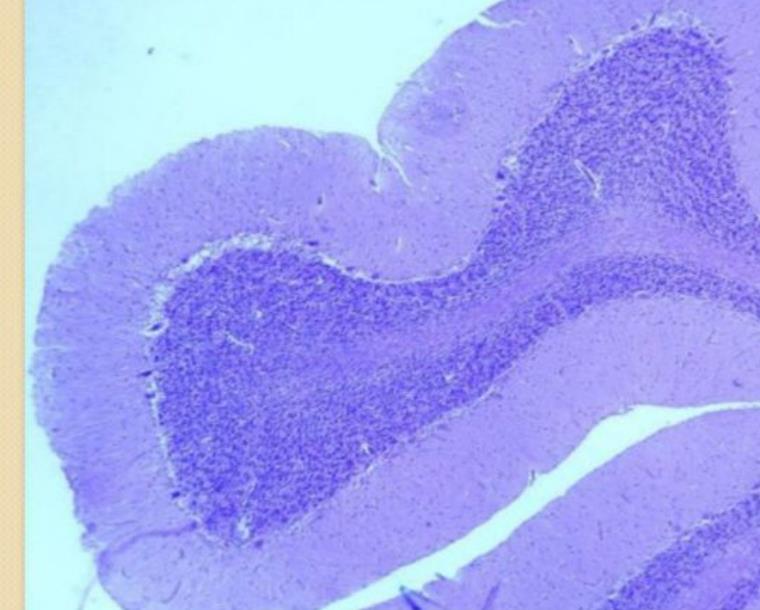
- Cerebellum - folia, a cortical mantle, and central medulla are visible (Aponeurosis — Histology Question Bank)
- A 18 year old girl presented with cystic SOL in the cerebellum. (pathology essays — Past Paper Questions & Answers)
- 6 year old girl presented with hydrocephalus and space occupying lesion in the midline of the cerebellum. (pathology essays — Past Paper Questions & Answers)
- Regions most involved include the basal ganglia, cerebellum, thalamus, hypothalams, and brainstem. (CNS PATHOLOGY — Past Paper Questions & Answers)
- Anatomical hierarchy (cortex → basal ganglia → cerebellum → brain stem → spinal cord → nerve root → plexus → cauda equina → nerve → neuromuscular junction → muscle) (CNS History Taking & Neurological Exam Guide | Clinical Skills)
Study material on Cerebellum
- MEDICAL PHYSIOLOGY II ESsays
- pathology essays
- systemic pathology essays
- Endocrine and Metabolic Pathology MCQs for Medical Students
- Medical Physiology IV (CNS)
- Medical Physiology Ii
Images
Practice questions on Cerebellum
The cerebellum receives input from the following sites EXCEPT:
- Cerebral cortex
- Spinal cord
- Brainstem nuclei
- Vestibular apparatus
Answer: D. The cerebellum receives extensive sensory and motor information from the cerebral cortex, spinal cord, and brainstem nuclei (e.g., vestibular nuclei). The olfactory bulb's primary connections are with other olfactory processing areas, not directly with the cerebellum for motor control.
Which portion of the cerebellum functions in the planning of sequential movement?
- Vermis and fastigial nucleus
- Intermediate zone and fastigial nucleus
- Lateral hemisphere and interposed nucleus
- Cerebrocerebellum and dentate nucleus
- Spinocerebellum and interposed nucleus
Answer: D. The cerebrocerebellum (lateral hemispheres) and dentate nucleus are involved in motor planning and coordination of complex, sequential movements. They receive input from cerebral cortex and are important for cognitive aspects of motor control. The other cerebellar regions have different functions related to balance, posture, and limb coordination. ---
Which structures in the cerebellum have a topographical representation of the body?
- The dentate nucleus
- The lateral hemispheres
- The flocculonodular lobe
- The vermis and intermediate hemisphere
- The cerebellar peduncles
Answer: B. The vermis and intermediate hemisphere (spinocerebellum) have somatotopic organization with topographical representation of the body. The vermis represents axial muscles and the intermediate hemisphere represents limb muscles. The lateral hemispheres are involved in motor planning rather than direct body representation. ---
The cerebellum receives sensory input from ---
- Labyrinth
- Proprioceptors
- Eyes
- All of the above
- Usually mediated by non-specific mechanisms
Answer: D.
Climbing fiber input to the cerebellum comes from ---
- Superior olivary complex
- Red nucleus
- Inferior olivary complex
- Locus ceruleus
- Mostly unchanged in early disease
Answer: C.
Incorrect Mark 0.00 out of 1.00 Cerebellum receives input from the following sites EXCEPT ---
- All of the above
- B. Somatosensory pathways
- Labyrinth & vestibular nuclei
- Motor cortex
- Visual impulses from tectum Your answer is incorrect. The correct answer is: Motor cortex
Answer: A.